Thursday, November 24, 2022

Brazil: The Monarch Composer - Ensemble PHOENIX on period instruments. Vivid performance of this seldom-performed early-19th century repertoire awaits Israeli audiences

Emperor PEDRO I (who proclaimed Brazil's Independence) painted by Simplício Rodrigues de Sá. 


Throughout history, members of royal families have shown talent in playing musical instruments, singing or composing music, most often at a gifted amateur level, giving public performances at home or on royal visits abroad.  Alfonso X of Castile, Prince Louis Ferdinand of Prussia, Frederick II of Prussia and Liliuokalani of Hawaii, to name a few, composed music, but perhaps the most famous musician of royalty was Henry VIII of England, who was esteemed as a composer, and it is known that he played the cornett, regal, flute, virginals, recorder, lute, harp and organ.


People attending "Brazil: The Monarch Composer", Ensemble PHOENIX's upcoming concert, are about to make their acquaintance with another royal composer - D. Pedro I, de Alcântara e Bragança (1798-1834) of Brazil. In fact, all the works performed in this concert will be by Brazilian Classical composers and all will be Israeli premieres. We will hear Pedro's Credo in C major (1829), Padre José Mauricio Nunes Garcia's Pastoral Mass for Christmas Night, Marcos Portugal's Overture "Il Duca di Foix" (1805) and the anonymous early 19th century "Lundu da Cachaça" (the lundu, a popular dance, was an antecedent of the samba). All will be played on Classical period instruments.


Once again, Brazilian-born PHOENIX founder and musical director, researcher and viola da gamba player, will offer concert-goers a new and exciting experience. She will conduct Ensemble PHOENIX and The Madrigal Singers (director: Italy Berkovich). Soloists will be soprano Monica Schwarz, mezzo-soprano Noa Hope, tenor Itamar Hildesheim and Gili Rinot - classical clarinet.


Celebrating 200 years of Brazil's Independence, this powerful program of early 19th century Brazilian music will be a first in Israel, with works of both naive and grandiose character, with the lundu leaning more towards traditional folk idiom. And for those of us interested in historically informed performance, in hearing (and, indeed, seeing) these works played as they would have sounded in the Classical period, the event is sure to be a celebration!


Friday 02.12.22 at 12:00

Jerusalem, St. Vincent de Paul Church, Mamilla Mall 

Reservations: 052-3784586

Tickets: https://ticks.co.il/event.php?i=vymU0m85xO1 


Saturday 03.12.22 at 12:00 

Haifa, St. John Anglican Church, 30 Khuri St.,

Reservations: 052-3784586 

Tickets: https://ticks.co.il/event.php?i=vymU0m85xO1   


Friday 09.12.22 at 12:00

Tel Aviv-Jaffa - St. Peter's Church

1 Mifratz Shlomo 

SOLD OUT!


Saturday 10.12.22 at 12:00

Magdala ("The Pompeii of Galilee"), Duc In Altum Church 

Reservations: 052-3784586  

Tickets; https://ticks.co.il/event.php?i=vymU0m85xO1 


Tuesday, November 22, 2022

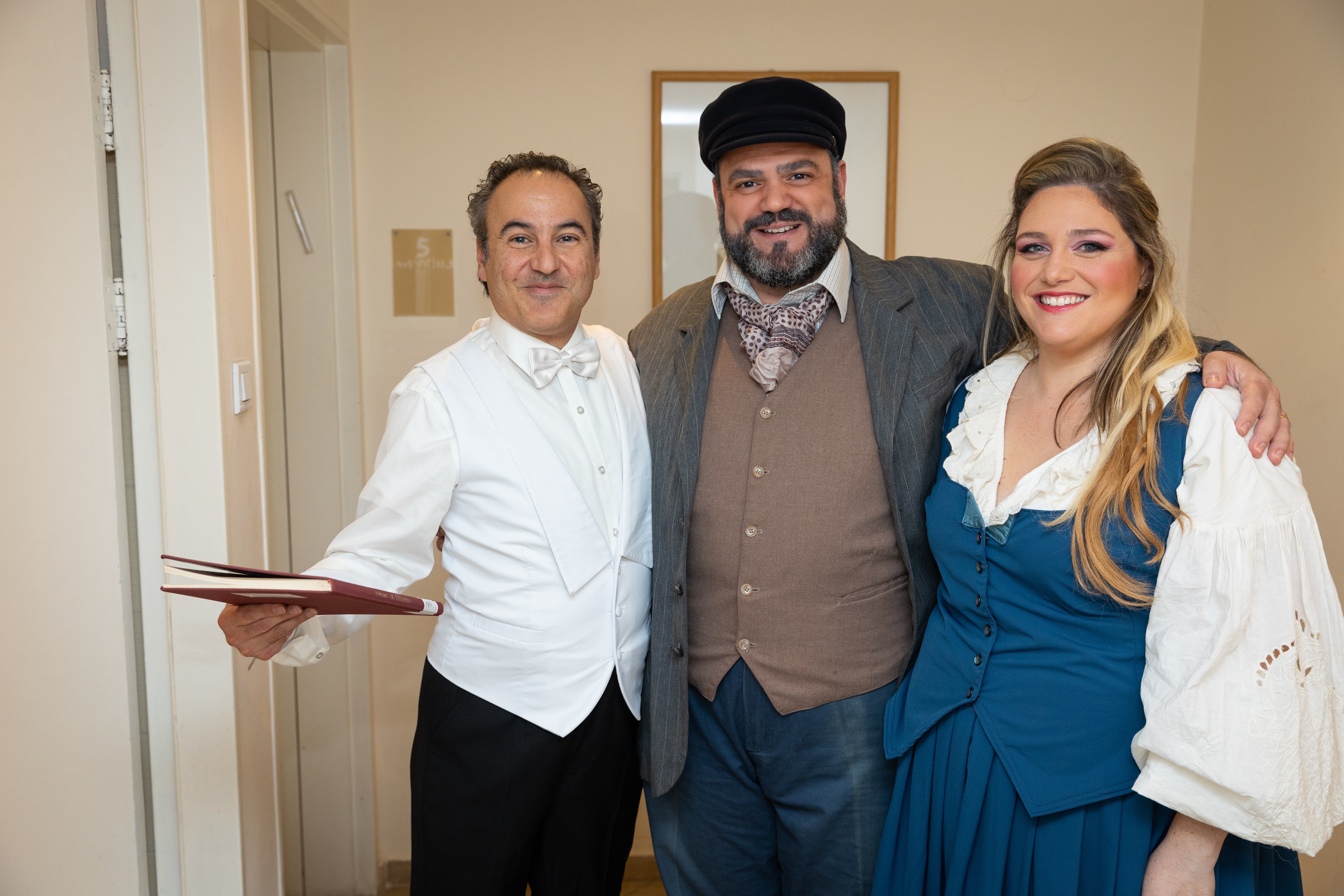
Giacomo Puccini's "Il Tabarro" (The Cloak) - the Jerusalem Opera opens its 2022-2023 season with a fine performance of this post-Romantic opera

Omer Arieli,Daniel Luis de Vincente,Yasmine Levi-Ellentuck (Elad Zagman)


At the front of the stage, the bow of a boat, a life buoy, some sacks and crates create a tasteful setting for Giacomo Puccini's passionate late masterpiece "Il Tabarro" (The Cloak). Taking place in the Henry Crown Auditorium of the Jerusalem Theatre on November 19th 2022, this was the Jerusalem Opera's first performance for the 2022-2023 season. Conducting the Jerusalem Symphony Orchestra (its players seated on stage) and a line-up of fine Israeli and overseas singers was Maestro Omer Arieli, the Jerusalem Opera's musical director and house conductor. Stage director was Daniel Lasry. Costumes, sets and props - Shira Wise.


Set on the banks of the Seine, this one-act opera tells the story of barge owner Michele, who suspects his young wife Giorgetta of being unfaithful. Packed with side plots and characters bringing to life the sights and sounds of 1910, the opera reaches its dramatic conclusion when Michele unexpectedly catches his wife’s lover. Featuring in this dark tale of love, loss, adultery and murder were US-born baritone Daniele Luis de Vicente as Michele, soprano Yasmine Levi-Ellentuck in the role of Giorgetta and Ukraine-born tenor Vitaliy Kovalchuk as Luigi, Giorgetta's lover. Well cast, each gave articulate and convincing expression to the concentrated dramatics with outstanding vocal performances, each artist so different in character, each endearing him/herself to the audience. In addition to Michele's pivotal aria "Nulla…Silenzio!", the audience was treated to opera performance endorsing some of Puccini’s most stunning vocal writing. The other singers made for a colourful band, their different human agendas, sometimes high-spirited (and drunken) actions, striking a clever balance with the more intense and ill-fated main plot. No new face to opera stages in Israel, mezzo-soprano Noa Hope, playing the sassy Frugula, always delights with her lively stage presence and easeful singing. 


Maestro Arieli reads well into the melodrama of Il Tabarro, highlighting the brilliance of one of Puccini’s most modern and impressionistic scores. He and the Jerusalem Symphony Orchestra gave precision and attention to the fine detail, shaping and beauty of the instrumental score, sharing the plot and emotions with Intensive orchestral involvement, drama, surprising contrasts, musical predictions, comments and some surprises. Take, for example, the French waltz played by a desperately out-of-tune street organ; Puccini scores this with clarinets and "out-of-tune" flutes, playing not in octaves but in major sevenths.


The original idea for “Il Tabarro” had come to Puccini in Paris in 1912. He wrote: " I already have the idea for the veristic opera; the story will be based on a play by a not-so-well known French playwright called Didier Gold. It is a romance tragedy that takes place on a barge. I find life on the docks quite intriguing. The docks swarm with workers, boatmen and ordinary people. This gives a lot of opportunity for life-like scenes both on the boat and ashore." The darkest of Puccini’s works is centered around the idea of passing time, metaphorically embodied by the time of sunset, by the Autumn season and, above all, by the slow, inexorable flow of the river, around which the whole story develops.


And a life-like and dynamic stage it was in the Henry Crown Auditorium! A fine opera performance, swift-moving, rich in emotion and marvellous music, here was the great opera composer at the very height of his powers, Puccini at his most verismo. The audience drank in every nuance, emotion and event of this small gem. Kudos to all involved. 


Established in 2011, the Jerusalem Opera’s goals are presenting opera productions of the highest quality in Jerusalem and the promotion of Israeli artists.

Daniel Luis de Vicente,Yasmine Levi-Ellentuck (Elad Zagman)

Lev Elgardt,Noa Hope (Elad Zagman


Yasmine Levi-Ellentuck,Vitaliy Kovalchuk (Elad Zagman)

Daniel Luis de Vicente (Elad Zagman)

Monday, November 7, 2022

"Lied in Fall" - The Israel Contemporary Players open the 2022-2023 season on an autumnal note


The Israel Contemporary Players opened their 2022-2023 Discoveries Series with "Lied in Fall" (Song in Autumn) in the Zucker Hall of the Tel Aviv Culture Center on October 22nd 2022. ICP artistic director Ilan Volkov conducted the players, with 'cellist Hillel Zori as soloist.


The program opened with "Schlammflocke II (Sludge Flakes) by German composer Carola Bauckholt (b.1959). Composed in 2010 for the Cologne-based Ensemble Musikfabrik, the curious trigger for this ensemble piece was the operation of water purification installations, in which sludge flakes (micro-organisms of dead and living material) play an important role. To produce the unique piece, the composer uses a wide range of resources, with the musicians playing their own instruments conventionally, but also generating a variety of animal sounds with such instruments as nose whistles and conventional instruments played in unconventional ways. The score shows accurately-notated pitch-, rhythm-, timbre- and dynamic signs, yet invites each player to give them his own meaning. What emerges is a tranquil background against which a dynamic scene emerges, a rich and exhilarating sound world of independent animal sounds and varied bird calls, from the most minute and delicate of gestures to nature's grand tutti. The listener is swept into the vivid scene, into a work that is experiential both aurally and visibly, beautiful and captivating,


Sarit Shley Zondiner (b.1984), a prominent Jerusalem composer, refers to her music as "ambiguous dramatic situations" that "find their expression in different combinations of sound, that fluctuate between normalcy and insanity." "Shoudu '' for ensemble and electric guitar is not the first work of hers to explore the darker, ambiguous nature of the inner world of the child. The composer refers to two Israeli writers of children's literature who address the subject - Miriam Yalan-Stekelis and Ronit Haham.  Shoudu, a devil wielding magical powers, a figure both fearful and humorous (even nice), appears in Haham's writings. In Shley Zondiner's work, unrelenting texture are strewn throughout, with finely-chiselled, chilling-, spectral- and otherworldly effects, melodic fragments and glissandi that surface and subside; but the core texture of the piece consists of wispy percussive effects, breathy sounds and even some disturbing effects of an uninvited guest gently knocking on a door. There is no mistaking that the piece evokes a child's most nightmarish imaginings. Volkov and the instrumentalists gave a detailed and fine-spun reading of the piece, one demanding much skill and delicacy. Kudos to Oded Geizhals on his very fine handling of the percussion role.  


Then to Anton Webern's 1920 chamber ensemble setting of his Six Pieces for large orchestra Op.6. The original version of the Six Pieces was premiered in Vienna in 1913, conducted by Arnold Schoenberg. The average length of each piece is 25 bars; the longest (No.4) having 41, the shortest (No.3), presented in just a few brushstrokes, a mere 11 bars in length. Volkov and the players addressed the fine detail, shades of meaning and emotion of each of the pieces. The Funeral March (No.4), opening with what must be one of the most chilling percussion sequences ever written, the instruments mostly shrouded in shadows of sotto voce, the haunting, penetrating clarinet solo, with the snare drum leading fatefully to the movement’s shockingly abrupt conclusion, was compelling. Altogether, the ensemble's warmth of sound and attention to such elements as pauses gave poignant expression to Webern's remarkable sensibility and ground-breaking musical syntax. Indeed, autumnal in mood, the work, according to the composer himself, describes episodes connected with his mother’s death.


And to the piece offering the concert its title - "Lied in Fall" (Song in Autumn) - by Danish composer Hans Abrahamsen (b.1952), a work for large chamber ensemble and 'cello solo commissioned by the London Sinfonietta, which also premiered the piece in January 1988. "Lied in Fall" is dedicated to prominent Danish composer Per Nørgård (b.1932). Abrahamsen describes the work thus: "In an autumnal landscape of falling lines, the 'cello moves about with delicate lyricism, almost singing its Lied. It is surrounded by shadows of what has been and what has yet to come, coexisting with melodies between these lines…" In this work, typical of the evocative narrative and nature imagery of the early period of Abrahamsen's career, the ensemble creates a vivid, dynamic screen of sound, against which Zori expounded the work's sweeping, songful melodies with bold delivery. Throughout the lush soundscape, wrought of two totally different and seemingly independent agendas, Volkov held both components in delicate and precisely-hewn balance, leaving the listener questioning himself as to where to direct his own personal spotlight at any given moment.


Established in 1991, the prestigious Israel Contemporary Players have added much to the country's musical life, enriching its audience's appreciation of contemporary music. The ensemble regularly commissions, performs and records works by Israeli composers, besides performing an international repertoire from the 20th- and 21st centuries. It collaborates with European and Israeli conductors and soloists and performs in Europe and Asia. The ensemble consists of 14 players.


Sunday, October 23, 2022

CHOOSE LIFE - a veritable journey. Myrna Herzog has recorded solo viol music from the 16th to 21st centuries

Jan Brueghel the Elder (1568-1625)  Flowers in a Wooden Vessel


CHOOSE LIFE, played by Brazilian-born Myrna Herzog, is a new and comprehensive recording of solo music for the viola da gamba - comprehensive as it includes works from the 16th-, 17th-, 18th- and 21st centuries, covering from the earliest works for the instrument through to contemporary pieces written for Herzog, comprehensive as it includes works of composers from Central Europe, Brazil, Japan, Israel and Russia, comprehensive because the pieces are performed on six different viols - five historic and one modern. Dr. Myrna Herzog has referred to the recording as a "sort of multi-layered story or film" displaying "the instrument's singing and chordal capacity...and an array of techniques".


Of the splendid early solo repertoire for the viol - works from Italy, England, dance suites by French composers and German works - Herzog plays a representative selection. She opens with two pieces of Venetian musician Silvestro Ganassi, whose second treatise of two volumes (1542,1543) is highly informative on playing the viol - addressing the technicalities of playing the instrument and subtleties of expression, including guidance on the playing of passaggi (ornamentation). Herzog's playing of these pieces is of the kind that invites the musical text to dictate shapes, its phrasing and the pieces' underlying air of mystery, preparing the listener to experience the compositional perfection of several more finely-crafted miniatures to be heard here. Venetian composer Giovanni Bassano's Ricercata Quarta, another small jewel, boasts a challenging and unpredictable melodic course. Here, Herzog makes a point that the beautiful modern instrument built by Spanish luthier Luis Fernández (b.1956) does justice to such a work. As to Herzog's arrangement of "Terra donde me criei", a strophic, anonymous 16th century Portuguese piece, its plangent, vocal character is expounded by way of her individual colouring of vocal lines: “Land where I was raised Who took me away from you? Sad I will always live, Crying because I have lost you.”  The stylistically beautiful and moving "Fantasie" of Nicolas Hotman is followed by a "Sarabande et double'' by him. Known to be an expert player of the lute, theorbo and the viola da gamba, Hotman spent most of his career in France, referred to as the teacher of violist Monsieur de Sainte-Colombe. Of the latter, a celebrated master of the viola da gamba, credited with adding the seventh string on the bass viol, Herzog's playing of "Les Pleurs" (The Tears) is flexed, expressive and rich in "narrative".  As to the music of Sainte-Colombe le Fils, written in England, the bold, lively folk-like bourdon-based "Vielle" (this referring to  the vielle-à-roue or hurdy-gurdy) and played on the traditional English six-string viol, it nevertheless belongs to the French tradition in viola da gamba music, harking back to the style of his father and teacher. One of the recording's highlights is Herzog's personal reading of the younger Sainte-Colombe's mournful "Fantasie en Rondeau". Another student of Sainte-Colombe (the elder) was Marin Marais, represented here by two dances, Muzette I et II.


And to works by German-born composers. The recording includes two transcriptions Myrna Herzog has made of movements of solo works by J.S.Bach - the Sarabande from Violoncello Suite No.4 BWV 1010, played with majesty and elegance, highlighting the brighter and darker timbres of the viol, followed by her hearty reading of the "Gavotte en Rondeau" from Violin Partita No.3 BWV1006, this taken at a moderate speed in order to set off each gesture. Carl Friedrich Abel was a student at St. Thomas School, Leipzig, where he was taught by Bach, then to become one of the most renowned viola da gamba players of his day and composing important music for the instrument. A fashionable performer when the viola da gamba had become a rarity, Abel’s performances inspired a revival of interest among performers and audiences. Herzog's fondness for these Classical vignettes is reflected in her wide sweeping gestures as opposed to more introspective, winsome moments, her attention to melodic lines, selective use of ornamentation and strategic timing. She embraces these miniatures with the beauty of simplicity. At the age of 39, Abel moved to London in 1759, where he was appointed chamber musician to Queen Charlotte in 1764, hence Herzog's choice to play these pieces on viols by Edward Lewis (London, c.1685). 


Representing viol music of the British-born composers, Herzog devotes a significant part of the recording to music of  Tobias Hume, the enigmatic Scottish soldier and mercenary of foreign armies. Hume was a musician of great merit, known as a gamba player, indeed, a recognized composer promoting the virtues of the viol against those of the lute. From his two published lyra viol tablatures (1605, 1607) containing all his known works, she delivers Captain Hume's fine and distinctive (albeit non-virtuosic) writing with subtle shaping and sensitivity, as "Life" follows ebulliently from the plangent piece titled "Death". 


Fast forward to the 21st century and to a rich selection of pieces, six of which have been composed or transcribed for Myrna Herzog, an artist committed to playing contemporary viol music. She enjoys contact with the composers themselves, frequently collaborating with them to fashion music that is idiomatic for the instrument. In the series of small segments that make up "Sephardic Reminiscences", Israeli composer Dina Smorgonskaya (b.1947, USSR) combines both the exotic and the contemplative. Boris Yoffe (b.1968) is a Russian-born Israeli composer, today residing in Germany. Contemporary and largely monodic in style, also evocative, Yoffe's "Sonnet" (2006) is highly personal in character. In "Der kleine Bach" (2018), German composer, arranger, guitarist/keyboardist Günter Krause (b.1947) takes both performer and listener on an original and somewhat whimsical ride on a Bach-and Krause-tinted perpetuum mobile, its arpeggiated figures separated by "sighs". Melancholic, eastern European Jewish musical associations run through "Known Direction" and "Trains" by Israeli trumpet player, music educationalist and composer Aharon Shefi (b.1928, Jerusalem). "Trains" includes actual quotes of songs associated with the Holocaust, the train effects serving as a clear association of the deportation of Jews to Nazi camps. This was played on a late 19th century viol gifted to Herzog by her teacher, Judith Davidoff. Both of these two excellent pieces by Shefi are performed with profoundly personal and emotional focus. In "Nordestina" (2010), by Brazilian classical guitarist Luís Otávio Braga (b.1953), the listener becomes aware of Braga's involvement in the choro genre, a form of Brazilian popular music that emerged from the mix of European instrumentation and harmonies with Afro-Brazilian rhythms. A richly varied and colourful canvas, Braga's piece gives free rein to musical ideas and styles, as he takes into account the possibilities of the viol, also making reference to the guitar, the composer's own instrument. The final track on CHOOSE LIFE "A Bridge to the Past" was written by Japanese composer/conductor Shunichi Tokura (b.1948). A piece replete with nostalgic melodies, it was written for Myrna Herzog as a Brazilian modinha (a traditional-style Brazilian song), this alternating with phrases of Japanese melody. 


CHOOSE LIFE is an album whose detail and exquisite playing will appeal to connoisseurs and devotees of the viola da gamba. The pieces were recorded in various venues (2005-2021) by Eliahu Feldman and David Feldman and splendidly mastered by David Feldman. Most were recorded during the Corona pandemic. Herzog's playing addresses all aspects of performance on the instrument, extending beyond technical considerations. In addition to showcasing the viola da gamba's "boundless possibilities of expression" in Herzog's words, the program takes on another dimension, symbolizing the wanderings of Herzog's family. Its title was inspired by the artist's father, Leon Herzog, a Polish Jew who survived the Holocaust and emigrated to Brazil. He maintained that "every day we must choose life anew". The album can be heard on several digital platforms.


Sunday, September 18, 2022

A house concert of Jewish organ music performed and explained by Dr. Yuval Rabin at his Jerusalem home

Dr, Yuval Rabin (courtesy YR)


Not every day does one attend a pipe organ concert in a private home, but this was indeed the case on September 6th 2022, with people gathering at the Jerusalem home of Yuval Rabin to hear a concert of Jewish organ music performed on the 21-stop, German-built organ in his home. 


As one mostly associates organ music with church buildings and repertoire, this seemed an atypical program for an instrument mostly found in churches. Dr. Rabin opened the event with an outline of the history of the organ both in the synagogue and in Jewish music in general. Many of us are familiar with the choral music of Polish-German composer Louis Lewandowski (1821–1894), much of it for mixed chorus, solo, and organ, written during his tenure as musical director at the Neue Synagoge in Berlin - appealing, highly melodic music composed in the strict four-part harmony of church music, but with many of the pieces based on ancient cantorial modal melodies.  Rabin included a number of Lewandowski's appealing organ pieces from "Fünf Fest-Präludien" Op. 37 and "Synagogen-Melodien" Op. 47, all brimming with colour, noble, festive (and choral) gestures and threaded with quotes from familiar synagogue melodies.


Born in Lvov, virtuoso concert pianist and conductor Julius Chajes (1910-1965) fled to Palestine, then settling in the USA in 1937 and making an enduring contribution to the music of American Jewry - to American Synagogue repertoire, largely in the Reform milieu, but also in many Conservative synagogues, as well as to the secular Jewish concert repertoire of his adopted country. The musical language of his "Prayer" for organ, based on a traditional melody by J. Neumann, is a testament to Chajes' extensive work with cantors when he served as musical director for the Jewish community in Detroit.


The program included organ works of three German-born Israeli composers. Conductor and singer Karel Salmon (1897-1974), settled in Palestine in 1933, becoming musical director of the Palestine Broadcasting Service (later, Kol Israel), also teaching at the Academy of Music in Jerusalem. His "Six Miniatures for Organ" constitute a fine example of the "Mediterranean style" period of Israeli music, merging the composer's European heritage with Middle Eastern-, Mediterranean- and Jewish folklore material. Rabin gave an articulate, vivid and intelligent reading of the small vignettes, each inspired by a specific source of traditional Jewish melody, bringing out Salmon's detailed treatment of each.

Yuval Rabin spoke of Paul Ben Haim's "Prelude" (1966) as based on the gesture of a Seufzer (sigh). The artist's performance of the small, multi-sectional piece gave rich and engaging expression to its moods and richly coloured soundscape. Composer, conductor, pianist and teacher Paul Ben-Haim (1897-1984), his musical palette also a mix of European styles and local orientalism, remains one of the greatest and most prolific of the founding fathers of Israeli music. 

A fine sample of the compositional style of Haim Alexander (1915-2012) was heard in Rabin's playing of "Meditations on a Yemenite Song", a movement from "The West-East Bridge", a work (and, indeed, its title) indicative of the composer's aim to create a national style with Middle Eastern- and folk-like styles, yet still remaining close to his European background, at the same time, staying in line with contemporary developments of music. Rabin coloured the free variations and their differing ideas and patterns by way of a variety of registers and daring forays, making for excellent listening. 

The program also included a work by Rabin himself - "Fantasia on Sabbath Zemirot" (songs sung around the table during the sabbath and on Jewish holidays.) A demanding and somewhat programmatic work, the songs emerge via a variety of textures, as Rabin engages in some canonic writing, his harmonies at times bordering on clusters; there are humorous and mysterious touches and moments of imposing organ timbres. Rabin's style is personal, appealing and certainly challenging to the player. His explanations throughout the evening made for lively discussion with the audience.

Born in Haifa, Israel in 1973, Rabin studied at the Dunie Weizmann Conservatory (Haifa), the Jerusalem Academy of Music and Dance, the Musik Akademie der Stadt Basel and the Schola Cantorum Basiliensis (Switzerland.) He participates in festivals and performs internationally with ensembles, orchestras and choirs. His CD recordings include “Organ Music from Israel'' and works of C.P.E Bach and Mendelssohn.


Saturday, September 10, 2022

Works of Bach, Schoenberg and Brahms in Concert No.3 of the 2022 Jerusalem International Chamber Music Festival

Dmitry Sitkovetsky (courtesy Jerusalem International Chamber Music Festival)


Once again, the Jerusalem International Chamber Music Festival was here to provide music-lovers with late-summer enjoyment, its excitement and energy drawing large crowds and filling the auditorium of the Jerusalem International YMCA to capacity. The 25th Jerusalem International Chamber Music Festival (artistic director: Elena Bashkirova) took place September 5th-10th, 2022. Arriving at the venue, one was greeted by Jerusalem's balmy evening breezes and the magical carillon sounds emanating from the YMCA bell tower, as Gaby Shefler entertained festival-goers with a selection of familiar melodies.


The Jerusalem International Chamber Music Festival boasts its very own distinctive features. One is that it brings together musicians from all over the world - young artists performing on stage with more veteran musicians. Another is its concert programming, with each concert offering new- or seldom-performed works and, in some cases, offering a different slant on familiar pieces, all these alongside the canon of chamber music repertoire. Concert No.3 (September 7th) was no exception. It opened with six of J.S.Bach's Three-Part Inventions, BWV 787-801, as set for violin, viola and 'cello by Dmitry Sitkovetsky. Performing them were Sitkovetsky (violin), Hartmut Rohde (viola) and Xenia Jankovic on 'cello. So many of us have studied these 3-part keyboard Inventions (or Sinfonias) in our youth, then to revisit them later with a wider perspective. For the minor-key inventions, Sitkovetsky chose slow tempi, tempi that might not be effective on the harpsichord, but here, on strings, resulting in poetic, lyrical playing that gave prominence to each and every motif. As to the inventions in major keys, the trio members let down their hair to perform them with contrapuntal pizzazz, inviting the listener to follow how Bach plays out the subject matter in each. These perfectly-chiselled jewels, the very same notes that Bach had penned, but seen through the prism of the string player, made for a splendid opener to the concert. 


Arnold Schoenberg's Ode to Napoleon Op.41 for narrator, string quartet and piano would not be a work often performed on these shores, if at all. Composed during World War II as a protest against tyranny, Lord Byron's poem castigating Napoleon served the composer in expressing his own feelings. An impelling and turbulent piece, rich in motifs and written in the manner of inflected speech (resembling Sprechstimme) Schoenberg makes several references to Beethoven. Conducted by Sitkovetsky, the artists displayed fine-tuned teamwork. Presenting the 12-tone score with feisty precision, the instrumentalists (Nathalia Milstein-piano, violinists Yamen Saadi and Mohamed Hiber, Hartmut Rohde-viola, Astrig Siranossian-'cello), together with narrator (baritone) Dietrich Henschel, brought out the work's compelling message, its sarcasm and scorn. Schoenberg had insisted that the narrator must have "the number of shades, essential to express one hundred and seventy kinds of derision, sarcasm, hatred, ridicule, contempt, condemnation, etc., which I have tried to portray in my music." Henschel did not disappoint, presenting the work's compelling message in a performance that was indeed gripping, resonant and genuinely theatrical.


These items were followed by three works of Johannes Brahms.  "Zwei Gesänge" Op.91, published 1884, had a strange genesis - to mend the marriage of violinist Joseph Joachim and wife mezzo-soprano Amalie Weiss (both musical partners of Brahms and personal friends), due to Joachim’s paranoid delusions about an affair he imagined Amalie was having with Fritz August Simrock, Brahms’ publisher. Performing the two songs at the Jerusalem concert were soprano Dorothea Röschmann, Razvan Popovici-viola and Sunwook Kim (piano), their beautifully balanced reading of “Gestillte Sehnsucht” (Longing at Rest, Rückert) and “Geistliches Wiegenlied” (Sacred Lullaby, Geibel) - both songs sharing the image of wind in trees, calming in the first and alarming in the second - sensitive, dynamic and evocative. With fine-sculpted musical gestures, Popovici constantly reached out to interact with Röschmann's poignant singing and beauty of timbre. 


In the late summer months of 1865, having left Vienna for a working vacation in Baden, near the Black Forest, Brahms rented an apartment with mountain views and began to imagine the Horn Trio while walking in the woods. His mother, Christiane, had died the previous February in Hamburg. The Trio in E-flat major for horn, violin and piano Op.40 brings together three instruments the composer had played as a young man. (Despite his great love for the instrument, Brahms only engaged the horn in one chamber music work.)  What quickly became clear at the Jerusalem concert was how wholly and naturally the three young outstanding artists - Ben Goldscheider-horn, Clara Jumi-Kang-violin and Nathalia Milstein - had delved into the musical and emotional meaning of this nostalgic and strangely modern piece, identifying with its controlled sentimentality, its agitated and impetuous moments, its urgent gestures, elegiac expressiveness and Romantic warmth. Ben Goldscheider wields the unforgiving horn with easeful mastery and richness of timbre. 


The event signed out with Brahms' Piano Quintet in F-minor Op.34, a dark, mighty work of huge scope, often considered to be Brahms' great chamber music epic, though completed when he was only thirty-one. Performing it here were violinists Dmitry Sitkovetsky and Mohamad Hiber, Gérard Caussé-viola, Tim Park-'cello and Sunwook Kim-piano. With both piano and strings playing an equally important role throughout this work, the artists created the whole-of-Brahms emotional journey in playing that was personal, lyrical, mysterious, fresh and with some subtly-flexed touches. 


Saturday, September 3, 2022

Taking place in Tel Aviv for the second year running, the 2022 Abu Ghosh Festival (October 11th-13th) will offer a rich selection of musical events

Vocapella Limburg (photo: Florian Lill)


As in 2021, the upcoming Abu Ghosh Festival will once again be held in Tel Aviv, taking place from October 11th to 13th 2022.  Popular from the 1950s as an annual event, the festival's organization was taken over in 1992 by music-lover Gershon Cohen and choral conductor Hanna Tzur, the revamped festival then happening twice a year. Attended by music-lovers from far and wide, people have been flocking to the two Abu Ghosh churches to hear the festival concerts, also enjoying the craft stalls, outdoor events and the relaxed, holiday atmosphere. As the Kiryat Yearim Church is presently undergoing renovation, the Sukkot Festival will take place at the Yitzhak Rabin Centre in Tel Aviv. The Rabin Centre, located on a hill, boasts commanding panoramic views of the Yarkon Park and of the city of Tel Aviv, with beautiful grounds and three concert venues – the Leah Rabin Hall, the Round Hall and the Triguboff Gardens nestling in the spectacular grounds. As of 2021, a new team has taken over the running of the festival, most of its members active on the Israeli music scene - Amit Tiefenbrunn - music director, Tessa Harari - management and production, Alon Harari - production coordinator and Yeela Avital - participation director and fundraising. The team has set its sights at creating a multi-sensory cultural experience with music at its core, providing listeners with events of diverse musical styles - western classical music, regional-, ethnic-, folk-, jazz- and classical Israeli music. 


Here's a question: how do you prefer your concert program? Strictly classical? If so, you might like to attend Concert No.6: “Bach. Bach? Bach!”- the best of Bach’s Motets, Mass and Concerto for 2 flutes - featuring the Israeli Vocal Ensemble and the Barrocade Ensemble. Or Concert no.11: “Vivaldi - The Four Seasons/Mozart-Exultate Jubilate” with violinist Roi Shiloah and soprano Veronica Brook. Or two concerts introducing the festival's overseas guest choir - Concert no.12 “Motets and Madrigals-past to present'' and Concert no.15, “Shining Dreams'', both performed by Vocapella Limburg, an award-winning male choir from Belgium. In “Romantic Psalms”, Concert No.16, the Tel Aviv Chamber Choir and soloists, directed by Michael Shani, will present an all-Psalm program.  "The Reign of Love - Rome and Venice’s Baroque Opera Grandeur” (Concert No.20) will offer festival-goers a glimpse into some 17th- and 18th century Italian aristocratic families, their composers and operas of the time. 


But let's say the festival atmosphere tempts you to move “outside the box” and indulge in a little mixing of styles, you might just choose to hear “Mediterranean Sensuality” (Concert no.3), performed by the Mezzo Ensemble, an encounter between songs and dances of 17th century Europe and Greek music of the 20th century. “Carmen’s Jazz Vibe” (Concert No.4) promises a daring and electrifying program, in which soprano Daniela Skorka joins the Guy Mintus Trio. "La Folia" (Concert No.10) will present the concept of insanity as expressed in both early- and contemporary music. For this event, Inbar Solomon (recorders), Yizhar Karshon (harpsichord) and Amit Tiefenbrunn (viola da gamba) will be joined by choreographer/dancer Nirit Rakhbi. In a “Magical Mystery Tour” (Concert No.13), English Baroque music, Shakespearean music, early Celtic music and Italian opera will come together as performed by Sunita Stanislav (Scottish harp), Uri Schleifer (Irish fiddle), Genevieve Blanchard (Baroque flute) and soprano Yeela Avital.


Festival-goers can also choose from music of different countries and ethnic styles, from the toe-tapping music of Argentina in “Concertango - 100 Years of Tango from Gardell to Piazzolla" (Concert No.2) or traditional Celtic and Jewish music, gypsy rhythms and a touch of jazz improvisation, performed by the Tzalool Duo (Concert No.5). East meets west in an "Ethnic Celebration" (Concert No.7), a program that includes Bartok's "Romanian Folk Dances", but also Turkish, Armenian, and Israeli Music, as performed by the Galilee Ensemble. No new faces to Israeli audiences, members of the Hortus Musicus Ensemble (artistic director – Andres Mustonen) will take listeners on a whirlwind tour of the Balkans and the Orient. For those of us who are partial to American country music - getting a buzz from the songs of Bob Dylan, Hank Williams and Johnny Cash - the "Jacks of Diamond" players and vocalists will fit the bill with a "Folk, Bluegrass and Country Celebration" (Concert No.14). For people transported by the music of such greats as Mercedes Sosa, Dorival Caymmi, Villa-Lobos and Ariel Ramirez, Daniela Skorka and guitarist Eyal Leber will perform popular songs from Argentina, Brazil, Venezuela and Chile in “Latin-American Classics'' (Concert No,17). “Passion and Emotion” (Concert No.18), featuring singers Yasmin Levy and Yaniv D’Or with Ensemble Naya, will stir up emotions in an evening of Ladino and Spanish music, not to mention the wild, extreme sentiments of love, injustice, sadness and heartache to be experienced in “Fuego y Tierra” (Fire and Earth) (Concert No.19), a traditional Flamenco performance of song, guitar and dance.


And, no less important, festival-goers will have an opportunity to hear some of Israel's young, up-and-coming choral singers. Three of Israel's prominent youth choirs can be heard performing a wide variety of choral repertoire in “The Next Generation” (Concert No.8).


Winding up the 2022 Abu Ghosh Festival, the Rockberry Sisters, a unique all-female cover band, will indeed rock listeners into reliving the nostalgia of the “50’s and 60’s Greatest Hits” with songs of the Beatles, Aretha Franklin, The Monkeys, The Supremes, Elvis, The Beach Boys, and many more. The 2022 Abu Ghosh Festival also promises outdoor stalls selling up-market arts and crafts.


Ticket reservations:  https://www.goshow.co.il/pages/minisite/234