Sunday, June 11, 2023

The Kanazawa-Admony Piano Duo performs works inspired by tragic love at the Eden-Tamir Music Center Ein Kerem, Jerusalem


Tami Kanazawa, Yuval Admony (Clemens Wortmann)

For "Love Stories in Two Pianos", a concert of the Eden-Tamir Music Center's Glorious Sound of the Piano series on June 3rd 2023, duo pianists Tami Kanazawa and Yuval Admony performed works all based on love…an idyllic subject you would think for a morning concert on a sunny spring day in the magical Jerusalem village of Ein Kerem…  


The program opened with some of Johannes Brahms' "Liebeslieder Waltzer" (Love Song Waltzes) Op.52 (premiered Vienna,1870) a collection comprising eighteen songs originally scored for four vocal soloists (or choir SATB) and two pianos. Brahms chose to set poems from Georg Friedrich Daumer’s "Polydora", an 1855 German anthology of folk song texts from many countries. Due to the work's popularity and playability, many versions and transcriptions of the "Liebeslieder Waltzes" exist, including the setting we heard for piano duet (without voices), in which minor additions and intricacies were added to the original piano lines. Kanazawa and Admony conjured up the vividly pastoral texts relating to birds, stars, the moon and nature in general in playing that was both sensitive and subtle - at times reticent, gently lyrical and singing, positive and genial, even melancholy, at others, hearty, free-spirited and lavish. Their playing addressed each individual miniature, all of which deal with matters of the heart. And how birdlike and evocative No. 6 "A small, pretty bird" emerged. Much has been told of Brahms' amorous letdowns and his long-term friendship with Robert Schumann's wife Clara. However, it seems he had developed feelings for Robert and Clara’s daughter Julie. Distraught at Julie’s 1869 engagement, he completed his op. 52 "Liebeslieder Walzer" the same year.  


As to Franz Liszt's duet transcriptions of his own symphonic poems, they are not to be viewed merely as arrangements but as works that exist alongside the symphonic forms. Indeed, Liszt very often worked on the orchestral and two-piano versions simultaneously. At the Ein Kerem concert, we heard "Orpheus", Symphonic Poem No.4. The piece had its genesis in a performance of Gluck's opera "Orfeo ed Euridice" (1762), which Liszt produced in 1854 when music director of the Weimar Court. The composer was inspired by the depiction of Orpheus as seen on an Etruscan vase at the Louvre Museum and by the notion that Orpheus had a civilizing effect on humanity. With consummate teamwork, Kanazawa and Admony recreated the dilemma and struggle of the fateful Orpheus and Eurydice fable, represented on Liszt's broad canvas, with its pungent dissonances, and in the musical language of the 1850s, but also in pensive, fragile moments, showing Liszt at his most delicate, as well as at his most harmonically inventive. 


Liszt's "Réminiscences de Don Juan" (S. 418) is an opera fantasy for piano on themes from Mozart's 1787 opera "Don Giovanni". Composed in 1841 and published as a two-piano version in 1877, the piece is no paraphrase of the popular Mozart opera, rather, an interpretation, even a portrayal of the title character as seen through Liszt's eyes (understandably, the result being anything but condemnation of Don Juan's licentious life!)  Although extreme in technical demands, indeed, considered to be one of Liszt's most taxing works (Ferruccio Busoni referred to  the "Réminiscences" as carrying "almost symbolic significance as the highest point of pianism") Kanazawa and Admony concerned themselves with presenting the many-layered weave of the work that  draws on three themes from Mozart's opera, opening with the intense depiction of Don Juan's eventual confrontation with the flames of hell as vivified in sinister timbres of the pianos' lower register. As to the much-loved aria melodies threaded throughout, the artists presented them with cantabile good cheer and warmth. One could not object to the gentle humming of these jewels as was heard in the hall.


“The radioactive fallout from "West Side Story" must still be descending on Broadway this morning,” wrote Walter Kerr, critic of the Herald Tribune following the work's New York premiere. Considered by many to be Broadway's greatest contribution to the arts and Leonard Bernstein's most memorable work, "West Side Story" (conceived by Jerome Robbins, lyrics: Stephen Sondheim, based on a book by Arthur Laurents) was composed between 1955 and 1957. In 1961, Bernstein chose numbers from the score for his "Symphonic Dances from West Side Story", overseeing the orchestration carried out by Sid Ramin and Irwin Kostal. Performing John Musto's arrangement for two pianos, Kanazawa and Admony gave expression to the tragic love story set against the rivalry between two teenage street gangs of different ethnic backgrounds in New York's Upper West Side, to its tensions, to its slick undertones, devious characters and to its fragile, disarming tenderness. With strategic collaboration and consummate mastery, the artists presented the work's extravagant canvas, one rich and candid in jazzy rhythms, in temperament and moods, all coloured with dissonances and cross-rhythms, highlighting Bernstein's sophisticated writing. And how poignantly each of the memorable songs emerged, threaded between sensitively wrought transitions.


Remaining in the seething back alleys of America, the artists performed Percy Granger's "Fantasy on Porgy and Bess". Considered by many to be America’s first great opera, "Porgy and Bess" composed by George Gershwin (libretto: DuBose Heyward, lyrics: Ira Gershwin) tells the story of Porgy, a disabled black street beggar living in the slums of Charleston. It deals with his attempts to rescue Bess from the clutches of Crown, her violent, possessive lover, and Sportin' Life, her drug dealer. Kanazawa and Admony's performance called attention to Grainger's profuse and daring setting - its virtuosic two-piano "orchestration", complete with bell- and xylophone effects and its sultry, tough, noble and tender moods. The duo's playing of Gershwin's timeless melodies, one gorgeous, sparkling tune soaring up to meet another, created a pageant of intense human emotions, as the artists invited the audience to join them for the ride. 


Always informative and entertaining, Prof. Admony introduced each of the works. The stories of love represented here ended tragically, but the works written around them made for an elaborate and colourful program and  engaging performance. Real-life partners Tami Kanazawa and Yuval Admony, a piano duo for almost 30 years, perform internationally, take part in music festivals and were co-founders of the Israel International Piano Duo Festival, of which Yuval Admony is the artistic director. They conduct piano duo master-classes in Canada, Korea and Japan and are adjudicators of solo and chamber music competitions in Italy and Israel. 


Sunday, May 28, 2023

Conducted by Avner Biron, the Israel Camerata Jerusalem performs Handel, Copland and Piazzolla. Soloists:Julia Rovinsky (harp) and accordionist Teodoro Anzellotti (Italy/Germany)


Julia Rovinsky (www.camerata.com)

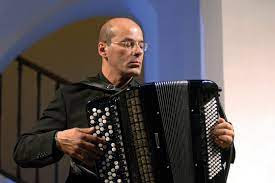
Teodoro Anzellotti (www.camerata.com)

Attending "From the Peaks of America", a concert of the Israel Camerata Jerusalem's "Passion for Music" series in the Henry Crown Auditorium of the Jerusalem Theatre on May 23rd 2023, took the listener to America, but also further afield. The program, conducted by the Camerata's founder and music director Avner Biron, featured two soloists - harpist Julia Rovinsky and accordionist Teodoro Anzellotti (Italy-Germany).


The event opened with George Frideric Handel's Concerto for Harp and Orchestra in B flat major, Op.4 No.6. The British Library boasts an autographed score of the “Concerto per la Harpa” by G. F. Handel, written in 1736, a musical intermezzo for the premiere of “Alexander’s Feast” at Covent Garden. In the piece, the composer wished to evoke the minstrel Timotheus’ masterful playing of the lyre in the oratorio. "Alexander’s Feast", which tells the story of how a bard used music to manipulate Alexander the Great in the celebration after his conquest of Persia; hence the use of lavish displays of instrumental sounds. Handel wrote this concerto for the Welsh harpist Robert Powell, whom he admired for his virtuosity. Four of Handel’s full-scale concert pieces were heard at the festive premiere - his "Ode for St. Cecilia’s Day", the "Alexander’s Feast" Concerto Grosso, his Organ Concerto in g minor and, quite remarkable for its time, the Harp Concerto. The latter was later published as a work for organ and orchestra, and is most often heard today performed on the organ, but its pared-down orchestration, muted violins, and pizzicato bass parts still point to the fact that it was originally conceived for the harp. Julia Rovinsky's playing was radiant and beautifully poised, her sound fresh and rich in dynamic contrast as she created interest with each different gesture and mood of the opening Andante allegro. No less dynamic was the Larghetto, lyrical, noble and pensive, her playing of Grandjany's cadenza emerging as a rich canvas of ideas and harp techniques, to be followed by the sheer dancelike joy of the final Allegro moderato. Although the Camerata is not a period orchestra, the modest number of players chosen here for the work and their clean instrumental sound made for an ensemble favourable to Baroque music, the splendid balance of orchestra and harp calling attention to Rovinsky's bold sense of line, indeed, to the unique possibilities of the harp itself. For an encore, Julia Rovinsky gave an appealing and sincere rendition of "Chat without Words" by Israeli composer Al Ravin.


It was the legendary American music patron Elizabeth Sprague Coolidge who commissioned Aaron Copland to compose a ballet for dancer/choreographer Martha Graham. The composer was aware that this work - "Appalachian Spring" - was to reflect "the pioneer American spirit, with youth and spring, with optimism and hope,” in his own words. With neither the season nor the mountains on Copland’s mind when he composed the work, he collaborated with Graham to delineate the characters of the ballet, its storyline telling of the events of an entire day, from the morning of the young couple’s wedding (in one of the most effective musical evocations of sunrise ever composed) to the evening. From the ballet (1944), Copland extracted a suite and scored it for full orchestra, this earning him the Pulitzer Prize for Music in 1945. The work, going beyond the world of dance, has remained a beloved icon of American culture. Copland’s “Appalachian Spring” marvellously evokes an idyllic sense of country and landscape, the folk element is strongly present (with reference to square-dance rhythms) as it features a set of variations on the Shaker song “Simple Gifts.” Maestro Biron's reading of the suite had a fine, natural flow, sensitivity to colour and to the shaping of phrases. At times, nostalgic, fleet and delicately textured, at others, exuberant and energetic, the leaping dance rhythms were taut and sinewy; hearty utterances emerged with some touches of humour. With many solos allotted to the woodwinds, these moments rose out of the orchestral weave with poignance and beauty of timbre. Although to some listeners certain movements might tend to sound a little drawn out without the visual aspect of dancers on the stage, the "Appalachian Spring" Suite is indeed a splendid concert piece, its score featuring the unique tonings of pandiatonic harmony (in which a tonal centre is created while avoiding traditional formulas) in charming, well-crafted and uncontrived writing. Signing out with a velvety cluster, the Camerata's performance was characterized by a sense of delicacy, sparkle and imagination.


Astor Piazzolla composed his Concerto for Bandoneón, Strings, Harp, Piano and Percussion in late 1979. It was a commission from the Banco de la Provincia de Buenos Aires. The composer himself was soloist at the premiere on December 15th of the same year.  Also given the title of “Aconcagua” by his publisher Aldo Pagani, who considered the work the peak of Piazzolla's oeuvre (Aconcagua is the highest mountain peak in South America), the Concerto for Bandoneón garnered Piazzolla the title of “the Villa-Lobos of Argentina” .Although the bandoneón, a button accordion (invented in Germany by Heinrich Band in the 1840s), its sound described  by John Henken, the Los Angeles Philharmonic's Director of Publications, for its "moaning wheeze, seductive and sarcastic", characterising the quintessential sound of the tango, it is not unusual to hear this concerto performed on the accordion, as was the case at the Jerusalem concert. Collaborating deftly with Avner Biron and members of the Camerata, Italian-born accordionist Teodoro Anzellotti (known for integrating the accordion into the sphere of classical music) brought the spirit of Argentinean music and the palpable elements of Piazzolla's real-life- and musical world into the Henry Crown Auditorium. Setting the scene, the opening Allegro marcato burst into life with the typically Argentinean intensity of Piazzolla’s brand of tango, his complicated harmonies and stinging dissonances, sultry moments and melancholy. In solo sections and moving tastefully through the orchestral weave, lending a rich voice to the melody, Anzellotti expresses each turn of mood. Beginning with the accordion alone, ultimately joined by the harp (Julia Rovinsky) in an elegantly reflective duet, the Moderato movement's dream-like burgeoning also featured solo violin (concertmaster Natasha Sher) alongside the accordionist. The highly spirited final movement included some distinctive, intimate moments - as, for example, when the accordion engaed in duet with gentle percussion sounds. In this work, Piazzolla provides the soloist with ample opportunities for drama, pathos and virtuosity. Add to those the sophistication and subtlety Anzellotti infuses into his music-making. Teodoro Anzellotti then gave a touching rendition of “Chiquilin de Bachin” (The little boy at Bachin), a deliciously sentimental waltz-tango, also by Astor Piazzolla. 


The audience enjoyed the Israel Camerata Jerusalem's delightfully imaginative programming.


Sunday, May 21, 2023

Yuval Benozer conducts the Rishon LeZion Orchestra with the Israeli Vocal Ensemble in Haydn's "Creation". Vocal soloists: Tali Ketzef, Ron Silberstein, Yair Polishook


Adam and Eve in the Garden of Eden. Peter Wenzel (1743-1829)

“The story of the creation,” Joseph Haydn wrote in 1801 “has always been considered the most sublime and awe-inspiring image for mankind. To accompany this great work with appropriate music could certainly have no other result than to heighten these sacred emotions in the listener’s heart, and to make him highly receptive to the goodness and omnipotence of the Creator.” Attending the Israel Symphony Orchestra Rishon LeZion's performance of Joseph Haydn's "Creation" on May 16th 2023 at the Tel Aviv Performing Arts Center was an experiential affair. Joining the orchestra was the Israeli Vocal Ensemble, whose conductor and music director Yuval Benozer conducted the performance. Soloists were soprano Tali Ketzef, tenor Ron Silberstein and baritone Yair Polishook. For the benefit of Hebrew speakers, actor Eli Gorenstein's readings of passages from Genesis were interspersed throughout the performance. 


During his first visit to London, Haydn attended one of the great Handel festivals held in Westminster Abbey and was completely overwhelmed by the experience, the result of which being that he resolved to write an oratorio himself that would be worthy of Handel’s supreme examples. Returning to Vienna, Haydn brought back with him an English oratorio text (now lost) - "The Creation of the World". Based on that, he set to composing "Die Schöpfung" (The Creation), a work blending the ideals of the Enlightenment with those of Romanticism, a work designated to be heard by people from any religious tradition or of none, by intellectuals and common people alike.  Its three sources are Genesis, the Biblical book of Psalms and John Milton's "Paradise Lost". Haydn had shown the English libretto to Baron Gottfried van Swieten, a central figure in Vienna's musical and literary (not to mention political) circles. Swieten set out to prepare an oratorio text in German for Haydn; how much of the original English libretto was used is open to conjecture. Intending the new work to be presented in London as well as in Vienna, Haydn’s idea was that it should be sung in either German or English.  When the initial edition appeared in print in 1800, it was the first choral work ever to be published with the text appearing in two languages. The story is told by three angels: Gabriel (soprano), Uriel (tenor) and Raphael (bass). The chorus mostly represents the heavenly host, commenting on the action and praising God for his acts of creation. Haydn uses what, for his day, was a rather large orchestra: The results were beyond anything he could have imagined. From the very start, "The Creation" was an enormous success, remaining one of the cornerstones of choral repertoire. A person present at one of the first performances in 1798 wrote the following: "No one, not even Baron van Swieten, had seen the page of the score wherein the creation of light is portrayed...and in that moment when light broke forth for the first time, one would have said that light-rays darted from the composer’s blazing eyes. The enchantment of the electrified Viennese was so profound that the performers could not proceed for some minutes."


Maestro Benozer's concept of the work felt right throughout, with tempos judiciously chosen and forces sizable (or powerful) enough to evoke the effect of the work's earliest performances, as true to the composer's intent. Haydn’s famous moments were vividly conveyed as Benozer invited soloists, chorus and orchestra to revel in the work's sublimely beautiful word painting, both vocal and instrumental, its startling dramatic gestures and bold orchestral colours. From the very outset, the audience was connected and enthused as the oratorio.was thrillingly brought to life, with Haydn’s astonishing depiction of the Genesis creation story emerging with fine articulacy and richly daring dynamic contrasts. 


The success of any performance of "Creation" hinges much on the soloists, to whom: Haydn has allotted some superb, albeit demanding sections. As Uriel, Ron Silberstein's performance, never oversung, came across as clear, controlled and expressive, his warm timbre conveying the brightness inherent in several of the oratorio texts – as he, for example, depicted a "brilliant sunrise, then a languid moonrise" (In splendour bright is rising now). Tali Ketzef (Gabriel, Eve), contending well with the large orchestral and choral forces, (exercising a touch too much vibrato for my taste) gave a performance that was eager and fresh, one highlight for me being her delicate, evocatively cooing description of the eagle, the lark, the dove and the nightingale in "On mighty wings the eagle proudly soars aloft", joined- and enhanced by the flute (Margalit Gafni). As Raphael (also Adam), baritone Yair Polishook's profound scrutiny of texts and dramatic instinct, served by his fine diction and imposing, majestic vocal delivery, made for a memorable and gripping performance, also with some lovely lyrical moments. In "At once Earth opens her womb", he matched his own fantasy with Haydn's gentle sense of humour to present the line-up of newly-created creatures (each with musical illustration) - the lion, tiger, stag, horse, cattle, sheep, insects and even worms - commencing the aria in Hebrew, then moving back into English. Once again, the Israeli Vocal Ensemble gave a performance that was of true intonation, precise, polished, rich in colour and dynamic contrast, replete with moments both powerful and fragile. The Rishon LeZion Orchestra complemented the work's dramatic- and musical demands, also offering some splendid orchestral interludes.  Eli Gorenstein's rendition of the relevant Biblical passages was articulate, communicative and presented with a touch of naivete and humour. 


From the work's opening description of chaos, evoked by harmonic aimlessness, set within the context of C minor, with fragments of melodies going nowhere in boundless primordial disorder through the darkness, prior to when we hear God’s words uttered by the angel Raphael  pronouncing the first words of the Old Testament, from the creation of light, through the vivid series of tableaux, to Adam and Eve’s love duet, Haydn's "Creation" offers depictions of the most dazzling scenes of unspoilt nature -  of birds, flora and beasts - to culminate in soaring choruses celebrating the creation of the world in life-affirming sounds. The giant final chorus of praise is preceded by Uriel making just a passing reference to the next chapter in the story: - the entrance of sin into this perfect world. The three angels sing solo episodes in this movement but they are joined by an alto soloist for four bars (here, a member of the Israeli Vocal Ensemble) to make up a solo quartet. Haydn was a deeply religious man. His devotion, however, was not of the gloomy, suffering kind, but rather cheerful and reconciled, a profound statement of an optimistic and assured faith and of a belief in music's ability to edify, uplift, and inspire the listener. Indeed, "The Creation" is a work larger than life!


Yuval Benozer (agfestival.co.il)


Wednesday, May 3, 2023

"Bach in France, Couperin in Germany" Ensemble PHOENIX on period instruments offers some interesting thoughts on Bach and Couperin's chamber music


Bach in France, Couperin in Germany? Did I hear correctly? What we do know is that J.S.Bach never left the region of his birth in Germany and that Couperin certainly never travelled to Germany. In the series currently being performed by Ensemble PHOENIX, founder and director Myrna Herzog is "throwing down the gauntlet" to her listeners in this rather unique program. 


A hint: "L'Impériale", the third suite (ordre) of François Couperin's "Les Nations", makes reference to the Holy Roman Empire of the German People, which formally lasted until 1806. However, you might just find this music distinctly French and conservative in style. The dances themselves are Couperin's most beautifully turned in the old style - discreet and flowing, but with a wealth of expressive detail. And be prepared to hear one of the most sublime fugues in musical repertoire! Myrna Herzog feels this movement might well be Couperin paying homage to J.S.Bach.


As to J.S.Bach's Ouverture in the French Style BWV 831, is this keyboard work based on a lost version for ensemble? Musicologist Dr. Alon Schab makes this argument credible. He has arranged it for two violins, viola, viola da gamba and harpsichord. The result is astounding in its rich weave and voice play. In the obituary for his father, C.P.E. Bach writes: “While a student in Lüneburg, my father had the opportunity to listen to a band kept by the Duke of Celle, consisting for the most part of Frenchmen; thus, he acquired a thorough grounding in the French taste, which in those regions was something quite new...” C.P.E. Bach also writes that among the music studied and loved by his father, there were works by “several good Frenchmen.”  Bach’s interest in the forms of French music is especially evident in his harpsichord suites, BWV 806-817, and Ouvertures BWV 820 (assuming its authenticity), 822 and 831.


Not to be missed.


Performed by a line-up of fine artists: Lilia Slavny, Noam Schuss– Baroque violin

Miriam Fingert – Baroque viola   Marina Minkin – harpsichord

Myrna Herzog - bass viol, musical direction


Wednesday 03.05.23  at 20:00
Tel Aviv, Studio Annette, the Felicja Blumental Music Center
Shvil HaMeretz 2

Saturday 06.05.23 at 11:00 am
Jerusalem, the Eden-Tamir Center, Ein Karem
https://eventbuzz.co.il/lp/event/f1fjk

Monday 08.05.23 at 20:00
Ra'anana, The Chamber lounge, Ra'anana Pais Music Center, 48 Etzyon St,
https://ticks.co.il/event.php?i=tR1uixJlr61


Noam Schuss,Lilia Slavny,Marina Minkin,Myrna Herzog,Miriam Fingert (Eliahu Feldman)

Sunday, April 30, 2023

The world premiere of Michael Wolpe's Choral Fantasy followed by Beethoven's Symphony No.9 at the Jerusalem Symphony Orchestra's 2023 Independence Day concert. Conductor: Steven Sloane

Prof. Michael Wolpe


It was April 25th, the eve of Israel's 2023 Independence Day and the air in the Henry Crown Auditorium of the Jerusalem Theatre was alive with joy, expectation and a touch of trepidation. The hall was packed to capacity, with concert-goers attending the Jerusalem Symphony Orchestra's festive concert honouring 75 years of the State of Israel. Conducting was JSO music- and artistic director Steven Sloane. We were to hear two large and interconnected works - the world premiere of Michael Wolpe's Choral Fantasy for choir, soloists, piano and large orchestra, to be followed by Ludwig van Beethoven's Symphony No.9 in D minor, Op.125, "Choral". The concert featured the Chamber Choir of the Jerusalem Academy of Music and Dance (director: Stanley Sperber) and the Tel Aviv Collegium Singers (director: Yishai Steckler), Tom Zalmanov (piano), soprano Ilse Eerens (Belgium), Israeli-born contralto Noa Frenkel, tenor Liviu Indricau (Romania) and British-born bass baritone Simon Bailey. 


On April 25th, Michael Wolpe (b. Tel Aviv, 1960) wrote: "This evening, on the seam between painful memorial days and the 75th Independence Day of our beloved and troubled country, against the background of all the events happening around us, a work of mine will be premiered by the Jerusalem Symphony Orchestra, the Jerusalem Academy of Music Choir and the Collegium Choir, pianist Tom Zalmanov and solo singers."  Wolpe's Choral Fantasy for choir, soloists, piano and large orchestra (2023) was clearly inspired by Beethoven's 9th Symphony, both in its grand setting - large orchestra, choir and four vocal soloists (here, with the addition of the piano) - and by the fact that it carries a strong social message. However, appearing 200 years later and composed in a location far removed from Central Europe, Wolpe's rich selection of texts by Jewish and Israeli poets is woven through the work's fabric together with the familiar music of Israeli songs and oriental dance rhythms, such as those inherent in the music of the Jews of  Yemen. In addition to texts sung by the choir and soloists, Prof. Wolpe himself added (and recited) his own spoken narrative to the multi-dimensional canvas. Falling into four sections bound together almost seamlessly, the Choral Fantasy includes texts of Russian-born Rachel Bluwstein (1890-1931), the Hebrew-language poet known as "Rachel", who immigrated to Palestine in 1909, of Tel Aviv-born poet Havatzelet Habshush (1950-1984), of Polish Hebrew/Yiddish modernist writer David Frischmann (1859-1922) and of the medieval Jewish Spanish Talmudic scholar Rabbi Shmuel HaNagid (993 AD-1056). Written in a highly accessible tonal/modal style, the huge choral and orchestral setting moved from foreboding moments to soulful, cantabile melodies, to infectious dance rhythms. The joint choir gave fine expression to Wolpe's masterful choral writing as the soloists' strong, resonant voices, mostly paired or singing as an ensemble, contended admirably with the massive forces on stage. Pleasingly handled by Tom Zalmanov, there was poetry in the piano sections, some solo, others weaving through the orchestral score. The third movement soars to a climax with the choir's vehement singing of David Frischmann's all-too-actual question: "Till when, till when, will man row with his brother?" In a work that is challenging, confronting and exhilarating, also abounding in melodiousness and associations of Israeli music, Wolpe's message comes across loud and clear, and with deep conviction. As to his rich choice of texts, the possibility of reading them as surtitles above the stage would have been advantageous to the audience.


With its close-to-impossible technical demands and the utopian humanist idealism in the choral setting of Friedrich Schiller’s "Ode to Joy" in the last movement, Ludwig van Beethoven's Symphony No.9 in D minor, Op.125,"Choral" has sometimes been referred to as the central work of western classical music both by those who view it as the quintessence of symphonic, technical, and compositional imagination and mastery, but also by those who claim that classical music can also embrace the world outside the concert hall, the work calling for social change, hope and even political reform. No symphony has been more widely discussed, nor has any other been a greater divider of musical opinion. For me, this was an opportunity to revisit Beethoven's 9th and, familiar as the work is to concert-goers, Maestro Sloane's direction of it had the people in the Henry Crown Hall at the edges of their seats, once again stirred and unsettled by the overwhelming drama, tension and turmoil of the first two movements, their suspense and jagged utterances, their expansive  triumphant and tender statements. The JSO's wind players added some splendid solo interludes. The symphony's heartfelt, mellow slow movement (Adagio) offered contrast and repose, with its variations on two gloriously warm-hearted themes. With the choral section of the final movement issued in by the bright, warm timbre of Simon Bailey's bass solo (always an electrifying moment when the baritone first sings) Beethoven's use of solo singers and chorus emerged as revolutionary and emotional as ever in the movement’s kaleidoscope of episodes. It was a performance of passionate conviction and excellence. This was the Beethoven work set for our time!


Sunday, April 23, 2023

Philippe Herreweghe conducts the Collegium Vocale Gent and the Israel Camerata Jerusalem in works of Mozart and Beethoven. Vocal soloists: Elisabeth Breuer, Olivia Vermeulen, Daniel Johannsen and Thomas E. Bauer


Photo: Shirley Burdick

It was difficult to assess which aspect of this program had drawn such a large audience - the line-up of outstanding artists or people's curiosity to hear seldom-performed works of Mozart and Beethoven. For me, it was both. Taking place in the Henry Crown Auditorium of the Jerusalem Theatre on April 16th 2023, "The Great Classic", a concert of the Israel Camerata Jerusalem's Instruvocal Series featured the Collegium Vocale Gent (Belgium), soprano Elisabeth Breuer (Austria), mezzo-soprano Olivia Vermeulen (Holland), tenor Daniel Johannsen (Austria), baritone Thomas E. Bauer (Germany) and eminent Belgian conductor and scholar Philippe Herreweghe. 


The event opened with “Calm Sea and Prosperous Voyage”, a short work for chorus and orchestra composed (1814-1815) by Beethoven to a text by Johann Wolfgang von Goethe. Beethoven loved Goethe’s poetry and set it to music repeatedly. A few years after the two met in 1812, Beethoven set Goethe’s popular pair of short poems "Meeres Stille" and "Glückliche Fahrt" as his opus 112, dedicating it to Goethe. Setting the scene for "Calm Sea", performance of the short tone poem opened with fragile, sotto voce choral timbres (the choir giving much emphasis to the various consonants) backed by plucked notes in the strings to evoke the motionlessness of a windless sea, then to be punctuated by Beethoven's startling treatment of “fürchterlich” (terrible), for example, highlighting  the word with a stinging dissonance, or of “Weite” (distances”) where, in the latter, a high soprano note in a sudden fortissimo crowns a massive  dissonant chord. Here, Beethoven enlists unorthodox procedures to convey the perilousness of sailing in such calm conditions. Issued in by a fluttering figure in the 'cellos, the journey is now underway again, with "Prosperous Journey", evoked in a massive choral and orchestral scene, rugged and fearfully joyous. Here, the audience becomes aware of Maestro Herreweghe's experiential approach to music (and poetry), with Collegium Vocale Gent (established by him in 1970) together with the Camerata players convincing in their expounding of the Romantic period's intrigue with storms and the sublimity of nature. It remains unclear why this substantive late Beethoven work has been condemned to obscurity and neglect. On completing it, the composer sent Goethe a copy, expressing that “I had united my harmony with yours in appropriate fashion.” Sadly, Goethe sent him no reply.


As to Ludwig van Beethoven's Symphony No.1 Op.21, the composer was 30 when it was first performed at the Burgtheater in Vienna. The Allgemeine musikalische Zeitung reported that “this proved to be the most interesting concert we have had in a long time" with Beethoven's symphony displaying "great artistry, innovation, and a wealth of ideas; except that the winds were overused, so that it was music for a band rather than for the whole orchestra.”  For me, hearing the work played by a chamber orchestra was a revelation. Herreweghe and the Camerata members brought out its fine details, nuances and colours, the work's vitality (the Menuetto is indeed a Scherzo!), its elegance, charm and sense of well-being. Add to those qualities Beethoven's audacity and teasing humour in the first- and fourth movements. Here was the music of a Beethoven not yet a burdened man, not yet a man grappling with fate. As to the criticism aired in the Allgemeine musikalische Zeitung following the symphony's premiere, the work indeed showcases the winds; the distinctive artistry and beauty of sound of the Camerata's wind players is never short of rewarding.


Accessible as it is to the listener, W.A.Mozart's Mass in C minor (Grand Mass) K.427 presents a number of unanswered questions. As to the task of completing it, Mozart wrote to his father on January 4, 1783: ."It is quite true about my moral obligation... I made the promise and hope to be able to keep it"...The fact remains that Mozart never completed the work. What is known is that it was first performed on August 25 1783 in St Peter’s Church, Salzburg. It is likely that Mozart's wife Constanze sang the high-lying first soprano part. Mozart himself may have presided at the organ. What is not known is how or, in fact, whether the missing sections were filled in at the Salzburg performance. And there is also no consensus on why Mozart wrote the C minor Mass. A perfect combination of all the genres and styles known in the late 18th century, from early polyphony to the galant style, it is nevertheless a wonderfully balanced musical unity, in spite of its incompleteness. Reconstructions of this tremendous creation only began in the early 20th century, instigated by the efforts of German musicologist Alois Schmitt. His pioneering edition has since been superseded, most significantly by that of American scholar H. C. Robbins Landon (and by several others, those including Robert Levin, Frieder Bernius/Uwe Wolf and Helmut Eder.) The version performed at the Israel Camerata Jerusalem concert was that of Robbins Landon. The work, featuring a double choir at the centre of each of its two halves, is a celebration of choral writing and Maestro Herreweghe and his very excellent Collegium singers certainly did not disappoint. The grandiose "Qui tollis" in G minor, probably the climax of the piece, with its haunting dotted rhythms, grating dissonances, chromaticism and extreme dynamic changes, emerged imposing and humbling. The lion's share of the solos belongs to the female singers. Enlisting her outstanding technical skills, soprano Elisabeth Breuer gave delicate and deeply moving portrayals of the “Christe eleison” in the “Kyrie” (taking on its two octave-and-a-half leaps with ease), then executing the coloratura passages of the composition’s vocal centrepiece "Et incarnatus est" with brilliance and poignance, the piece's intimate setting involving three solo instrumental lines at the hands of Muki Zohar (oboe), Mauricio Paez (bassoon) and Esti Rofe (flute). For the "Laudamus te", Olivia Vermeulen, her voice warm and finely-anchored, contended admirably with the dynamics, the shaping and melismatic course of the movement. Tenor Daniel Johannsen is no new face (indeed, no new voice!) to Israeli audiences. His profound understanding of sacred works always shines through his textual and musical delivery. The "Quoniam tu", featuring Breuer, Vermeulen and Johannsen, resounded radiant and exhilarating, indeed, constituting a highlight of what was altogether a sparkling performance. It was H.C.Robbins Landon who had referred to the last month of the year 1791 as "the greatest tragedy in the history of music" with the premature death of the thirty-five-year-old Mozart. 


Friday, April 7, 2023

"A Viennese Morning" - the Jerusalem Piano Duo performs works of Mozart and Schubert at the Eden-Tamir Music Center


The Jerusalem Piano Duo - Dror Semmel, Shir Semmel (Dan Porges)

"A Viennese Morning - Piano 4 Hands" could not have been a more fitting title to the concert performed by the Jerusalem Piano Duo - siblings Shir Semmel and Dror Semmel - at the Eden-Tamir Music Center, Ein Kerem, Jerusalem, on March 23rd 2023. Dr. Dror Semmel, artistic director of the Eden-Tamir Center, spoke briefly of the four-hand genre and the works on the program. 


The piano duet – four hands sharing one keyboard – was once an important part of musical activity, to be enjoyed at home and in the cultural salons of Europe during the 19th and early 20th centuries. In more modest times, the initial motivation to compose for piano four hands was not so much the medium’s creative potential, but rather for the opportunity it presented for enjoying proximity with one’s playing partner at a time when such things were otherwise frowned upon. The piano duet became increasingly popular as the modern piano was developing and being manufactured more cheaply, thus becoming the “must have” instrument for the home. Composers and especially music publishers capitalized on this by producing a wealth of sheet music for amateur pianists to enjoy. Of course, the abundance of piano duet material for pianists of all levels constitutes an important part of student=teacher repertoire. Music that is too much for one player is easier with more hands helping. Then followed works for four hands that were highly challenging and complex, catering to outstanding amateurs and professional players, today taking what began as domestic and salon music onto the concert platform. 


Franz Schubert left a large legacy of music for piano four hands, extending to some sixty works. Largely little-known today, most of these works were composed for domestic use at the Schubertiades hosted by the composer’s Viennese friends. The Ein Kerem concert opened with Schubert's much-loved Fantasy in F minor D.940, a work of four movements combined into one. As to its title, the work relates both to the act of "fantasieren" (German: improvise) and to "Fantasie" (imagination.) It was dedicated to Karoline Esterházy, one of the students Schubert taught on the Esterházy estates in Zseliz in 1818 and 1824. Legend has it that the dedication to Karoline Esterházy is indicative of a possible love affair between teacher and student. Opening with one of those heaven-sent Schubertian melodies, one occupying a fragile place between nostalgic, sad reminiscence and bliss, the artists gave expression to the manner in which the epic Fantasy unfolds, as it shifts between major and minor, contrasting shadow and light, sadness and happiness, with the artists (primo: Dror Semmel) displaying control, articulacy, clean, unblurred textures and subtlety, also exercising gentle flexing of tempi and giving articulate explication to its fugal writing and hearty tutti. 


Schubert's Allegro in A minor D.947 "Lebensstürme" (Storms of Life) was written in May 1828, the last year of his life. This title was not given by the composer but by Anton Diabelli who published it in 1840, presumably with an eye to the market. However, the stereotyped sobriquet does little to prepare the listener for the depth and breadth of what is in store. Possibly Schubert's star four-hand composition, written only a month after the Fantasy, it offers us more than a glimpse into Schubert’s inner life. The Jerusalem Duo artists probed the highly dramatic work, with its extensive use of chromaticism and Neapolitan sixth chords, a single-movement work which, by turns, is turbulent, passionate, tragic and blissful. They brought out some rapturous moments of floating, otherworldly fragility, their sensitively-shaped phrasing and powerfully built climaxes (in the fugue) emerging with conviction. 


Mozart was one of the pioneers of works for piano four hands, undoubtedly encouraged to do so through his music-making on the harpsichord together with his sister Maria Anna (Nannerl), as depicted in the famous family portrait by Johann Nepomuk della Croce (c.1780). As his musical career progressed, Mozart created a small repertoire of masterful four-hand piano compositions that remain among the most admired and performed of this genre. Sonata in F, K. 497, showing the composer exploiting the opportunities inherent in this distinctive style of writing, was a pioneering work, leading to impressive results. It is Mozart’s largest-scale four-hand sonata and the most ferociously difficult of them. Shir and Dror Semmel gave rhythmic spontaneity to the opening movement, a quest into imagination with its enthralling exchange of musical ideas, not to speak of the many moments echoing Mozart's operatic writing. The artists' performance of the Andante movement brimmed with invention and noble gestures, to be followed by their joyful but carefully paced playing of the final Allegro with its delightful series of interwoven sonorities. Ten months after completing the F major Sonata, Mozart finished his last full-scale foray into the genre of piano for four hands with Sonata in C major K 521. Instead of the tight interweaving of the four hands of K 497, Mozart establishes a more competitive relationship between the two performers, with many passages in which they imitate each other (with deviations). With Shir Semmel in the primo role, the artists launched into the extended opening Allegro with zest and freshness, navigating its dazzling dialogue with charm and fine contrasting. Following the full, virtuosic texture of the Allegro, they balanced the Andante's pared-down lyrical, dream-like outer sections with its more intense and contemplative middle section, taking on the sonata's final movement, a good-humoured Allegretto, at a moderate pace.


Performance by two pianists simultaneously sharing a single piano requires not only a level of intimacy unique to chamber music; it also presents its own set of technical challenges. Once again, Shir and Dror Semmel's performance brought home that the four-hand genre has qualities that can’t be found in any other form of collaborative playing, characterizing a melding of two players and four hands into one musical organism. Their performance was finely detailed, rich, polished and rewarding. Despite the fact that the four-hand piano repertoire is primarily associated with domestic music-making, the size and intimate ambience of the Eden-Tamir Music Center’s hall makes for a good second!


Mozart Family portrait painted by Johann Nepomuk della Croce