Sunday, July 30, 2023

Leonard Sanderman (UK) performs English organ repertoire and an original work at the Lutheran Church of the Redeemer in Jerusalem's Old City


© 2022 Leonard Sanderman 

It is rare to hear English organ music of the late 19th century-early 20th century on these shores. In his recital on July 23rd 2023 in the Jerusalem Lutheran Church of the Redeemer's annual July International Organ Festival, Leonard Sanderman (UK) presented works of this very repertoire together with a work of his own. The Right Rev. Joachim Lenz of the Redeemer Church welcomed the audience, commenting on the fact that the evening's program would be well suited to the church's Karl Schuke organ.


Prof. Sanderman spoke of English organ music as having gone through periods of popularity and times when it was less so. He spoke of the late 19th century as having produced a surge of organ music in Britain - not necessarily church music, but several ceremonial works and those written for entertainment. Opening the program with "Marche Héroïque" (1915) by Gloucester Cathedral organist Sir Alfred Herbert Brewer (1865-1928), Sanderman gave bold expression to the composer's most highly-favoured organ piece (possibly written as wartime propaganda!), its forthright opening section giving way to attractive cantabile moments, as the artist highlighted the work's antiphonal effects and Brewer's rich use of harmony. Although Sir Charles Hubert Hastings Parry (1848-1918) had a lifelong love of the organ, an instrument he had played from childhood, his most significant solo organ works for the instrument were written in the last few years of his life. Parry's most substantial organ work, the Toccata and Fugue "The Wanderer" (1912), of which we heard the Toccata at the Jerusalem concert, was named by Parry after his yacht. Sanderman's playing of the piece gave prominence to the work's  rich "orchestration" and sudden changes of mood and texture, indeed, to music suggesting the unsettled nature of wandering. It was also a reminder of the beauty, power and emotional content this forgotten English Romantic composer had incorporated into his fine compositional style. And to the opening Allegro Maestoso movement of Organ Sonata in G (1895) of Sir Edward William Elgar (1857-1934), a work that has been referred to as one of the most outstanding works of English Romantic organ repertoire. Sanderman met the high challenges of the piece, his performance not only portraying its vivid canvas and the scale and dexterity of the pipe organ, but also offering touching moments in his playing of its finely-shaped high-register personal melodic utterances. A felicitous opportunity to hear a movement of this far too-little-known masterpiece.


Moving into the 21st century for a short hiatus, the program included a composition of the artist himself - "An Harrogate Fanfare" for organ solo (2014) - commissioned and published by De Orgelvriend, a Dutch journal. Brimming with radiant organ timbres, this hearty, tonal piece spoke of joy and positive energy.


Of the program's works of a decidedly light-hearted nature, we heard A.H.Brewer's appealing and delicate (at times mysterious) arrangement of the Prelude to Act 3 of Sir Arthur Seymour Sullivan's incidental music to Shakespeare's "The Tempest". Composed when Sullivan was 20, his Op.1 a set of movements for the play, its success quickly brought him to the attention of the musical establishment in England. The name Berthold Tours (1838-1897) does not ring British. The Netherlands-born violinist/organist and music editor, however, moved to London in 1861. Sanderman bedecked the various sections of Tours' charming, up-beat "Allegretto Grazioso" with a variety of delectable timbral hues. Originally written for piano and violin, Elgar's "Chanson de Matin" was arranged for organ by Herbert Brewer. Sanderman's uncluttered reading of it was sensitive, beautifully contrasted and poetic. For an encore, the artist played a delightful improvisation in appreciation of the young woman who was his page-turner at the recital!


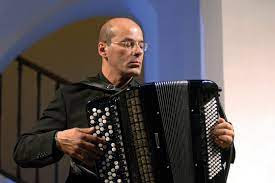
Initially taught the organ by his father, Leonard Sanderman (Holland, 1991) performs internationally. He is a prize-winning, commissioned composer and a published author on church music and the organ. His PhD focuses on issues in the historiography and canonisation of liturgical music in high church parishes between 1827 and 1914. A senior lecturer in Organ and Historical Musicology at Leeds Conservatoire, he also teaches Harmony and Counterpoint at the University of York. This was Prof. Sanderman's second visit to perform at the Jerusalem Redeemer Church.
 

​


Sunday, July 16, 2023

The Chaos String Quartet (Austria) performs works of Mozart, Beethoven, Henriëtte Bosmans and Diego Conti at the American Colony Hotel, Jerusalem


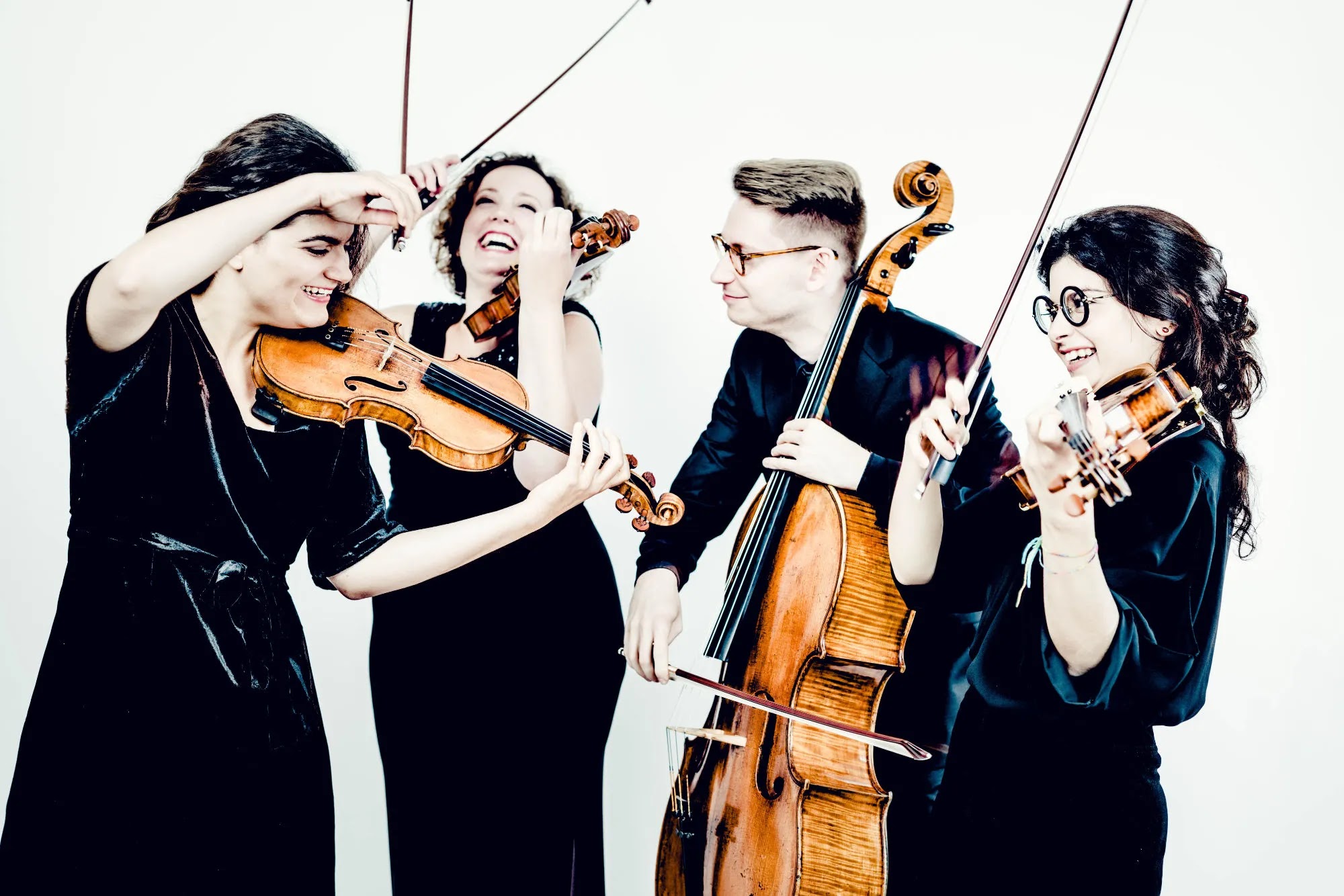
The Chaos String Quartet (©Andrej Crilc)

Under the auspices of the Austrian Cultural Forum, the Chaos String Quartet (Austria) - violinists Susanne Schäffer and Eszter Kruchió, violist Sara Marzadori and Bas Jongen (violoncello) - performed at the American Colony Hotel (Jerusalem) on July 9th 2023. Seemingly contradictory, the quartet's enigmatic name surely raises some questions (and perhaps a few eyebrows). However, it is based on Italian theologian and philosopher of religion Vito Mancuso's theory that "chaos plus pathos equals logos", from which the four artists understand chaos as the “original form of all creative”, by which art, science and philosophy can be joined in one artistic synthesis.  


Director of the Austrian Cultural Forum Tel Aviv, Arno Mitterdorfer welcomed the audience to the event. He spoke of the American Colony Hotel as a multicultural Jerusalem venue, as a suitable location for such concerts. Referring to the Chaos String Quartet as "an excellent shooting star", he promised those gathered in the ACH’s Pasha Room a journey taking the listener from works of Classical repertoire to music of a more contemporary European landscape.


Violinist Eszter Kruchió briefly explained the works to be performed. The concert opened with W.A.Mozart's String Quartet No.1 in G major, K.80, the composer's first string quartet effort, composed at age 14 in a tavern when he was on a vacation in Lodi, Italy. The work is written in the style of Italian chamber sonatas of the time, originally only comprising the first three movements. The French Rondo (final) movement was added two years later. From the very first sounds of the opening Adagio, one is drawn into the vibrant, rounded and full-bodied signature sound of this ensemble as the artists give expression to the work's charm, lyricism and interest, its majestic moments, its playfulness and whimsy, in playing that was effortless and beautiful. 


Then to a work of Henriëtte Bosmans (1895-1952), considered one of the most important Dutch composers of the first half of the 20th century. Her works are presently enjoying rediscovery. Bosmans was already enjoying a well-established reputation in Dutch musical life prior to World War II. As a pianist, she was affiliated with various chamber music ensembles in Amsterdam; her works were performed under such conductors as Willem Mengelberg, Ernest Ansermet and Pierre Monteux. However, being half Jewish, she fell into disfavour with the Nazi occupiers, who banned her from all public performances and she was forced to support herself with underground house concerts. Henriëtte Bosmans' parents had influenced her in the German Romantic style but her own musical bent took her in the direction of French Impressionists in an ongoing quest to find her own independent compositional language. Her String Quartet (1927), reflecting her sharply modernist bent, is an early product of this experimentation. Performed at the Jerusalem concert, it carries imprints of Debussy and Ravel, its polytonal, modal colouring, its dissonant elements and moments of exotica providing the nuts and bolts for the Chaos musicians' candid and intense reading of the work. As to the melancholic theme of the Lento movement (introduced by Schäffer) followed by the high-register 'cello utterance (Jongen), the artists provided reflective, albeit eerie relief from the mostly robust, uncompromising message of the work, as its final movement bowed out with a series of glissandi. 


The program at the American Colony Hotel also came with a premiere - "Une étoile dansante" (A Dancing Star) commissioned from Italian violinist/composer Diego Conti (b.1958). Typical of Conti's idiom of freely incorporated styles, the short work takes the players through a wide range of string-playing techniques - spiccato and con legno bowing, flageolets and more - to create a vivid and varied canvas of jagged gestures, of busy soundscapes, also intimate moments and heartfelt solos, inviting the players to indulge in Conti's mix of the harmony of dissonances, of Classical harmony, and to dip into in their large palette of dynamics. Not to be ignored is the fact that Conti came to his musical style via progressive rock, after which he immersed himself in 20th-century concert music, finally moving backwards through music history to study earlier styles. Taking the work's host of demands on board, the instrumentalists led the "dancing star" on a committed, impressive and vivid journey.


The quartet's final piece took audience and players back to Vienna, the Chaos String Quartet's nerve centre. Stemming from his first years in Vienna, Ludwig van Beethoven's Opus 18 needs little introduction as his initial step into the Classical string quartet genre, this opus being the only quartet contribution from his first period, the collection, however, providing the listener with proof that the composer was already a master of the form. The players' auspicious choice of the Op.18 No.3 Quartet in D major gave the stage to their fresh, sincere playing and to their comprehension of the work's delicate melodiousness and charm, as they highlighted each gesture of the first three movements with spontaneity, a sense of wellbeing and a touch of wistfulness. As to the Finale - galloping, virtuosic and richly contrapuntal - they juxtaposed its technical demands with its exuberance and (Haydnesque) wit as it exited with a teasing, quiet whisper. We tend to hear many late Beethoven works on today’s concert platforms. The artists’ performance of this quartet was a welcome reminder that the young Beethoven had produced music that was brimming with energy and variety, youthful optimism and passion, with invention and enthusiasm.


Remaining in Vienna, the quartet chose to perform Bas Jongen's arrangement of a Schubert Lied - "Nacht und Träume" (Night and Dreams), with Susanne Schäffer taking on the vocal line (text: Matthäus von Collin). The result was enchanting as the artists created the song’s otherworldly mood of night "floating down, Like your moonlight through the expanses of space"  


The evening's performance highlighted the exemplary and polished performance of each of the young instrumentalists, also their excellent teamwork. Add to these 1st violinist Susanne Schäffer's outstanding qualities of leadership and suave musicianship. Established in 2019, the Chaos String Quartet is rapidly establishing itself on the international concert scene. Winner of prestigious competitions, the quartet has been selected for the New Austrian Sound of Music sponsorship program. This was the quartet’s first concert tour of Israel.


REPORT THIS AD

REPORT THIS AD


Sunday, July 2, 2023

"Dolce e Coraggioso" - Gabriela Galván (traverso) and Isidoro Roitman (liuto attiorbato) record sonatas of Corelli, Barsanti, Platti, Vivaldi and Locatelli


Cover design Horacio D'Alessandro

Recently issued, "Dolce e Coraggioso" (Sweet and Brave), comprising works of Italian Baroque composers, is the third disc issued by Argentinian artists Gabriela Galván (traverso) and Isidoro Roitman (liuto attiorbato). Smaller than the archlute, the liuto attiorbato can be tuned to G and A, enabling the lutenist to play in sharpened keys, as are the works on this recording.


"Dolce e Coraggioso" opens with Arcangelo Corelli's Sonata Op.5 No.4 in G major. Written originally for violin, the Twelve Violin Sonatas, Op. 5 (Sonate a violino e violone o cimbalo, 1700) were the best-known instrumental sonatas during much of the 18th century (indeed, Corelli was feted by the aristocracy, cardinals, and royalty) and have been arranged for many different instruments. Playing from a score appearing on "Editorial Paris: Le Clerc le cadet, Le Clerc l'ainé, Boivin" (1754), the artists gave poignant expression to the contrasts dictated by the sonata da chiesa form, with Galván's playing at times elegant, poised and fragile, at others, vivid and energetic, ornamenting suavely and adding just a touch of the inégal. Reading from figured bass notation, Roitman's resourceful treatment of it abounded in interest, creativity and imagination. Here, one is reminded of Geminiani, who referred to Corelli as possessing "a nice ear and most delicate taste… pleasing harmonies and melodies…to produce the most delightful effect upon the ear”.


Francesco Barsanti is well known to recorder players for his highly idiomatic 6 Solo Sonatas for alto recorder Opus 1. Galván and Roitman's inventive, exhilarating and eloquent playing of Sonata No.2 in B minor from the composer's 6 Sonatas for German [transverse] Flute and Continuo Op. 2 (1728) shed light on the excellence of this less frequently heard collection. Once again, the figured bass allows Roitman's fantasy to take flight, to explore the lute's potential. Not to be ignored is the fact that Barsanti (1690-1772) was one of several extraordinary Italian instrumentalists, virtuosi and composers travelling across Europe, contributing decisively to the definitive success of instrumental music and the formation of an international musical language. 


No household name today, Giovanni Benedetto Platti (1697-1763) was known in his day as an exceptionally fine singer, instrumentalist and composer. He left his native Italy in 1722 to take up a position in Germany at the court of Prince-Bishop Johann Philipp Franz von Schönborn.  Straddling the late Baroque and early Classical eras, his "Sonatas for Transverse Flute" paint a vivid and engaging portrait of the 18th-century musician/composer himself. Galván and Roitman's playing of Platti's Sonata No.3 Op.1 was candid, fresh and charming, as they presented the composer's refined melodiousness with the timbral and tonal qualities that are an extension of the Italian Baroque style.


It seems that Antonio Vivaldi wrote as few as four sonatas for the transverse flute (RV48-51). Interestingly, none of these is characteristically Vivaldian and none brings to mind sonatas for other instruments. Performing Vivaldi's Flute Sonata in E minor RV 50, Galván and Roitman chose to call attention to the poésie common to all four movements - Andante, Siciliano, Allegro, Arioso - rather than effecting strong contrasts between them. The intimate soundscape they produced took shape via the cantabile character of its melodies, interesting use of motifs and of inégal- and extemporary rhythmic shaping on the flute, as Roitman added interest with such devices as spreads and with some melodic soupçons elegantly linking one passage to another.


The artists choose to sign out with Sonata Op.2 No.2 in D major of Pietro Antonio Locatelli's "Dodici Sonate", 12 Sonatas for transverse flute and bass (first published Amsterdam 1723). In playing that was strategically paced, genial, entertaining in its surprising turns of phrase and variety of expression, punctuated by the occasional coy and mysterious  gesture and enhanced with tasteful, fanciful ornamenting, Galván and Roitman drew attention to the composer's colourful personality (Locatelli was known to have  performed at the Prussian court wearing a blue velvet coat with silver trim,  precious diamond rings and carrying a sword), to the emerging style galant of the time as well as to  the increasing importance of the solo sonata genre, as they subtly highlighted the versatility of Locatelli’s writing.


For the recording of "Dolce e Coraggioso" Gabriela Galván plays a Baroque flute made by Martin Wenner, Singen, Germany (2018) a copy of an original by Carlo Palanca (c.1750.) Made by Paolo Busato, Padua, Italy, 2021, Isidoro Roitman's liuto attiorbato is a copy of an original by Matteo Sellas, Venice (1638.) Recorded in Buenos Aires, Argentina, in February 2023 (recording engineer Ariel Gato), "Dolce e Coraggioso" sounds natural and true, creating the intimate ambience required for this genre of chamber music. Once again, Gabriela Galván's informed approach, her unique signature timbre and sensitive musical shaping, joined by Isidoro Roitman's deep scrutiny of the composers' manuscripts and styles and his response to detail and gestures of the flute role, make for a rewarding listening experience to the discriminating listener.


The Embouchure Duo (Ariel Gato)


Tuesday, June 20, 2023

Mozart String Quintets K.515 and K.516 performed by Ensemble PHOENIX on period instruments at the Eden-Tamir Music Center, Ein Kerem, Jerusalem


 Myrna Herzog,Lilia Slavny,Noam Schuss,Miriam Fingert,Amos Boasson (Eliahu Feldman)

I don't remember the last time I heard Mozart string quintets played on the concert platform. Yet it is no secret that W.A. Mozart soared to new heights in his late works for five instruments - the four quintets for strings, all scored for string quartet with a second viola and the quintet for clarinet and string quartet, K. 581.  Ensemble PHOENIX's performance of String Quintets K.515 and 516 at the Eden-Tamir Music Center, Ein Kerem, Jerusalem on June 17th 2023 was an opportunity not to be missed. Also drawing listeners to the event was the fact that Ensemble PHOENIX performs on period instruments (Baroque instruments, Classical bows, gut strings, here tuned to A430 and in 1/6 comma temperament, as were organs of Mozart’s time) offering insight into how the quintets may have sounded when Mozart and his friends played them for their own diversion. Performing the works were Noam Schuss and Lilia Slavny (violins), Amos Boasson and Miryam Fingert (violas) and PHOENIX founder and musical director Myrna Herzog - 'cello.


1787 was a pivotal year for Mozart. With Vienna ringing out with melodies from the "Marriage of Figaro" that had debuted the year before, Mozart turned to work on what would become his operatic masterpiece, "Don Giovanni". Indeed, 1787 saw the completion and the debut of the latter. Taking a break, Mozart composed the pair of string quintets that would eventually be regarded as his greatest chamber music masterworks - the K. 515 in C major and K. 516 in g minor, writing them within a month of each other, shortly after learning of the death of his beloved father, Leopold. No concrete evidence exists as to the occasion(s) or musicians for which Mozart composed these string quintets. One theory is that Mozart wrote the quintets to win the favour of Frederick William II, the new King of Prussia, who happened to be a gifted cellist. H.C. Robbins Landon, on the other hand, suspects that the composer was “hoping to sell manuscript copies to amateurs by subscription.” (Amateur players would have found them technically daunting.)  As to why Mozart chose to write for the viola quintet, we do know that the viola was the stringed instrument Mozart preferred to play himself. These works show his love for the viola, placing emphasis on rich inner voices as well as on prominent lead roles for the first chair. Indeed, the close completion dates of these two quintets suggests that Mozart might have intended them as a contrasting pair - K. 515, in C major, characterized by optimism and confidence; with K. 516, in G minor, speaking of pessimism and despair. 


From the mammoth opening movement of the String Quintet No.3 in C major (Noam Schuss-1st violin, Amos Boasson-1st viola) to the closing Allegro, all tempi were moderate, giving the stage to the work's largely intense setting, its expressive use of tonality and chromaticism, the unique partitioning and grouping of parts among the five instruments fortifying inner voices creating new textures, and to the resourceful interplay of duets, antiphonal quartets and everything in between. Shaping gestures into deep musical meaning, Noam Schuss led and soloed judiciously, meeting at eye level with Boasson, also with Herzog, to convey the work's humanistic substructure.  As to the final movement (Allegro), we were presented with the richly sonorous resources of the quintet as well as with mirthful grandeur, so unmistakably Mozartian.


For the K.516 Quintet, Mozart's choice of g minor, a tonality associated with agitation and despair, is clearly no coincidence, indeed strengthened by the fact that the first movement's second theme also appears in the tonic minor. As the artists (Lilia Slavny-1st violin, Miryam Fingert-1st viola) present the opening Allegro (the upper three instruments untethered by the bass) in playing expressing restless, yet quiet agitation with a touch of reticence, Lilia Slavny (1st violin) brings out the work's sense of anguish as she leans into key notes, expressively engaging with Fingert (1st viola), also with Herzog. The despondent mood (and tonality) continues into the Minuetto (hardly minuet-like in spirit) characterized by a dark-and-light polarity, with tension added by the repeated appearance of the motif of two bitter, off-beat, ejaculatory chords. Throughout, Slavny's playing incorporated some tasteful ornamentation. Played with strings muted, with each motif strategically placed, the artists' heartfelt, inward-looking performance of the Adagio, its tragedy at times temporarily whisked away but never completely out of earshot, was profound and soul-searching. (On hearing the Adagio, Tchaikovsky chronicled experiencing a "feeling of resignation and inconsolable sorrow....I had to hide in the farthest corner of the concert-room so that others would not see how much this music affected me.”)  As to the final movement, the artists convincingly recreated its enigmatic course as it weighed in with a lengthy adagio introduction wrought of dissonance and unresolved tension, this to be swept away with the gallant elegance of carefree rondo dances in G major.


Hearing these two monumental works on authentic instruments and at the hands of five outstanding artists in playing that was poised and emotionally balanced was a rare experience. Keeping a safe distance from music-making that is precious or overwrought, the PHOENIX artists' performance was balanced, buoyant, intelligent and powerful, a performance reflecting their own enquiry into- and deep experience encountered in playing the quintets, both of which they conveyed to the audience. 


Sunday, June 11, 2023

The Kanazawa-Admony Piano Duo performs works inspired by tragic love at the Eden-Tamir Music Center Ein Kerem, Jerusalem


Tami Kanazawa, Yuval Admony (Clemens Wortmann)

For "Love Stories in Two Pianos", a concert of the Eden-Tamir Music Center's Glorious Sound of the Piano series on June 3rd 2023, duo pianists Tami Kanazawa and Yuval Admony performed works all based on love…an idyllic subject you would think for a morning concert on a sunny spring day in the magical Jerusalem village of Ein Kerem…  


The program opened with some of Johannes Brahms' "Liebeslieder Waltzer" (Love Song Waltzes) Op.52 (premiered Vienna,1870) a collection comprising eighteen songs originally scored for four vocal soloists (or choir SATB) and two pianos. Brahms chose to set poems from Georg Friedrich Daumer’s "Polydora", an 1855 German anthology of folk song texts from many countries. Due to the work's popularity and playability, many versions and transcriptions of the "Liebeslieder Waltzes" exist, including the setting we heard for piano duet (without voices), in which minor additions and intricacies were added to the original piano lines. Kanazawa and Admony conjured up the vividly pastoral texts relating to birds, stars, the moon and nature in general in playing that was both sensitive and subtle - at times reticent, gently lyrical and singing, positive and genial, even melancholy, at others, hearty, free-spirited and lavish. Their playing addressed each individual miniature, all of which deal with matters of the heart. And how birdlike and evocative No. 6 "A small, pretty bird" emerged. Much has been told of Brahms' amorous letdowns and his long-term friendship with Robert Schumann's wife Clara. However, it seems he had developed feelings for Robert and Clara’s daughter Julie. Distraught at Julie’s 1869 engagement, he completed his op. 52 "Liebeslieder Walzer" the same year.  


As to Franz Liszt's duet transcriptions of his own symphonic poems, they are not to be viewed merely as arrangements but as works that exist alongside the symphonic forms. Indeed, Liszt very often worked on the orchestral and two-piano versions simultaneously. At the Ein Kerem concert, we heard "Orpheus", Symphonic Poem No.4. The piece had its genesis in a performance of Gluck's opera "Orfeo ed Euridice" (1762), which Liszt produced in 1854 when music director of the Weimar Court. The composer was inspired by the depiction of Orpheus as seen on an Etruscan vase at the Louvre Museum and by the notion that Orpheus had a civilizing effect on humanity. With consummate teamwork, Kanazawa and Admony recreated the dilemma and struggle of the fateful Orpheus and Eurydice fable, represented on Liszt's broad canvas, with its pungent dissonances, and in the musical language of the 1850s, but also in pensive, fragile moments, showing Liszt at his most delicate, as well as at his most harmonically inventive. 


Liszt's "Réminiscences de Don Juan" (S. 418) is an opera fantasy for piano on themes from Mozart's 1787 opera "Don Giovanni". Composed in 1841 and published as a two-piano version in 1877, the piece is no paraphrase of the popular Mozart opera, rather, an interpretation, even a portrayal of the title character as seen through Liszt's eyes (understandably, the result being anything but condemnation of Don Juan's licentious life!)  Although extreme in technical demands, indeed, considered to be one of Liszt's most taxing works (Ferruccio Busoni referred to  the "Réminiscences" as carrying "almost symbolic significance as the highest point of pianism") Kanazawa and Admony concerned themselves with presenting the many-layered weave of the work that  draws on three themes from Mozart's opera, opening with the intense depiction of Don Juan's eventual confrontation with the flames of hell as vivified in sinister timbres of the pianos' lower register. As to the much-loved aria melodies threaded throughout, the artists presented them with cantabile good cheer and warmth. One could not object to the gentle humming of these jewels as was heard in the hall.


“The radioactive fallout from "West Side Story" must still be descending on Broadway this morning,” wrote Walter Kerr, critic of the Herald Tribune following the work's New York premiere. Considered by many to be Broadway's greatest contribution to the arts and Leonard Bernstein's most memorable work, "West Side Story" (conceived by Jerome Robbins, lyrics: Stephen Sondheim, based on a book by Arthur Laurents) was composed between 1955 and 1957. In 1961, Bernstein chose numbers from the score for his "Symphonic Dances from West Side Story", overseeing the orchestration carried out by Sid Ramin and Irwin Kostal. Performing John Musto's arrangement for two pianos, Kanazawa and Admony gave expression to the tragic love story set against the rivalry between two teenage street gangs of different ethnic backgrounds in New York's Upper West Side, to its tensions, to its slick undertones, devious characters and to its fragile, disarming tenderness. With strategic collaboration and consummate mastery, the artists presented the work's extravagant canvas, one rich and candid in jazzy rhythms, in temperament and moods, all coloured with dissonances and cross-rhythms, highlighting Bernstein's sophisticated writing. And how poignantly each of the memorable songs emerged, threaded between sensitively wrought transitions.


Remaining in the seething back alleys of America, the artists performed Percy Granger's "Fantasy on Porgy and Bess". Considered by many to be America’s first great opera, "Porgy and Bess" composed by George Gershwin (libretto: DuBose Heyward, lyrics: Ira Gershwin) tells the story of Porgy, a disabled black street beggar living in the slums of Charleston. It deals with his attempts to rescue Bess from the clutches of Crown, her violent, possessive lover, and Sportin' Life, her drug dealer. Kanazawa and Admony's performance called attention to Grainger's profuse and daring setting - its virtuosic two-piano "orchestration", complete with bell- and xylophone effects and its sultry, tough, noble and tender moods. The duo's playing of Gershwin's timeless melodies, one gorgeous, sparkling tune soaring up to meet another, created a pageant of intense human emotions, as the artists invited the audience to join them for the ride. 


Always informative and entertaining, Prof. Admony introduced each of the works. The stories of love represented here ended tragically, but the works written around them made for an elaborate and colourful program and  engaging performance. Real-life partners Tami Kanazawa and Yuval Admony, a piano duo for almost 30 years, perform internationally, take part in music festivals and were co-founders of the Israel International Piano Duo Festival, of which Yuval Admony is the artistic director. They conduct piano duo master-classes in Canada, Korea and Japan and are adjudicators of solo and chamber music competitions in Italy and Israel. 


Sunday, May 28, 2023

Conducted by Avner Biron, the Israel Camerata Jerusalem performs Handel, Copland and Piazzolla. Soloists:Julia Rovinsky (harp) and accordionist Teodoro Anzellotti (Italy/Germany)


Julia Rovinsky (www.camerata.com)

Teodoro Anzellotti (www.camerata.com)

Attending "From the Peaks of America", a concert of the Israel Camerata Jerusalem's "Passion for Music" series in the Henry Crown Auditorium of the Jerusalem Theatre on May 23rd 2023, took the listener to America, but also further afield. The program, conducted by the Camerata's founder and music director Avner Biron, featured two soloists - harpist Julia Rovinsky and accordionist Teodoro Anzellotti (Italy-Germany).


The event opened with George Frideric Handel's Concerto for Harp and Orchestra in B flat major, Op.4 No.6. The British Library boasts an autographed score of the “Concerto per la Harpa” by G. F. Handel, written in 1736, a musical intermezzo for the premiere of “Alexander’s Feast” at Covent Garden. In the piece, the composer wished to evoke the minstrel Timotheus’ masterful playing of the lyre in the oratorio. "Alexander’s Feast", which tells the story of how a bard used music to manipulate Alexander the Great in the celebration after his conquest of Persia; hence the use of lavish displays of instrumental sounds. Handel wrote this concerto for the Welsh harpist Robert Powell, whom he admired for his virtuosity. Four of Handel’s full-scale concert pieces were heard at the festive premiere - his "Ode for St. Cecilia’s Day", the "Alexander’s Feast" Concerto Grosso, his Organ Concerto in g minor and, quite remarkable for its time, the Harp Concerto. The latter was later published as a work for organ and orchestra, and is most often heard today performed on the organ, but its pared-down orchestration, muted violins, and pizzicato bass parts still point to the fact that it was originally conceived for the harp. Julia Rovinsky's playing was radiant and beautifully poised, her sound fresh and rich in dynamic contrast as she created interest with each different gesture and mood of the opening Andante allegro. No less dynamic was the Larghetto, lyrical, noble and pensive, her playing of Grandjany's cadenza emerging as a rich canvas of ideas and harp techniques, to be followed by the sheer dancelike joy of the final Allegro moderato. Although the Camerata is not a period orchestra, the modest number of players chosen here for the work and their clean instrumental sound made for an ensemble favourable to Baroque music, the splendid balance of orchestra and harp calling attention to Rovinsky's bold sense of line, indeed, to the unique possibilities of the harp itself. For an encore, Julia Rovinsky gave an appealing and sincere rendition of "Chat without Words" by Israeli composer Al Ravin.


It was the legendary American music patron Elizabeth Sprague Coolidge who commissioned Aaron Copland to compose a ballet for dancer/choreographer Martha Graham. The composer was aware that this work - "Appalachian Spring" - was to reflect "the pioneer American spirit, with youth and spring, with optimism and hope,” in his own words. With neither the season nor the mountains on Copland’s mind when he composed the work, he collaborated with Graham to delineate the characters of the ballet, its storyline telling of the events of an entire day, from the morning of the young couple’s wedding (in one of the most effective musical evocations of sunrise ever composed) to the evening. From the ballet (1944), Copland extracted a suite and scored it for full orchestra, this earning him the Pulitzer Prize for Music in 1945. The work, going beyond the world of dance, has remained a beloved icon of American culture. Copland’s “Appalachian Spring” marvellously evokes an idyllic sense of country and landscape, the folk element is strongly present (with reference to square-dance rhythms) as it features a set of variations on the Shaker song “Simple Gifts.” Maestro Biron's reading of the suite had a fine, natural flow, sensitivity to colour and to the shaping of phrases. At times, nostalgic, fleet and delicately textured, at others, exuberant and energetic, the leaping dance rhythms were taut and sinewy; hearty utterances emerged with some touches of humour. With many solos allotted to the woodwinds, these moments rose out of the orchestral weave with poignance and beauty of timbre. Although to some listeners certain movements might tend to sound a little drawn out without the visual aspect of dancers on the stage, the "Appalachian Spring" Suite is indeed a splendid concert piece, its score featuring the unique tonings of pandiatonic harmony (in which a tonal centre is created while avoiding traditional formulas) in charming, well-crafted and uncontrived writing. Signing out with a velvety cluster, the Camerata's performance was characterized by a sense of delicacy, sparkle and imagination.


Astor Piazzolla composed his Concerto for Bandoneón, Strings, Harp, Piano and Percussion in late 1979. It was a commission from the Banco de la Provincia de Buenos Aires. The composer himself was soloist at the premiere on December 15th of the same year.  Also given the title of “Aconcagua” by his publisher Aldo Pagani, who considered the work the peak of Piazzolla's oeuvre (Aconcagua is the highest mountain peak in South America), the Concerto for Bandoneón garnered Piazzolla the title of “the Villa-Lobos of Argentina” .Although the bandoneón, a button accordion (invented in Germany by Heinrich Band in the 1840s), its sound described  by John Henken, the Los Angeles Philharmonic's Director of Publications, for its "moaning wheeze, seductive and sarcastic", characterising the quintessential sound of the tango, it is not unusual to hear this concerto performed on the accordion, as was the case at the Jerusalem concert. Collaborating deftly with Avner Biron and members of the Camerata, Italian-born accordionist Teodoro Anzellotti (known for integrating the accordion into the sphere of classical music) brought the spirit of Argentinean music and the palpable elements of Piazzolla's real-life- and musical world into the Henry Crown Auditorium. Setting the scene, the opening Allegro marcato burst into life with the typically Argentinean intensity of Piazzolla’s brand of tango, his complicated harmonies and stinging dissonances, sultry moments and melancholy. In solo sections and moving tastefully through the orchestral weave, lending a rich voice to the melody, Anzellotti expresses each turn of mood. Beginning with the accordion alone, ultimately joined by the harp (Julia Rovinsky) in an elegantly reflective duet, the Moderato movement's dream-like burgeoning also featured solo violin (concertmaster Natasha Sher) alongside the accordionist. The highly spirited final movement included some distinctive, intimate moments - as, for example, when the accordion engaed in duet with gentle percussion sounds. In this work, Piazzolla provides the soloist with ample opportunities for drama, pathos and virtuosity. Add to those the sophistication and subtlety Anzellotti infuses into his music-making. Teodoro Anzellotti then gave a touching rendition of “Chiquilin de Bachin” (The little boy at Bachin), a deliciously sentimental waltz-tango, also by Astor Piazzolla. 


The audience enjoyed the Israel Camerata Jerusalem's delightfully imaginative programming.


Sunday, May 21, 2023

Yuval Benozer conducts the Rishon LeZion Orchestra with the Israeli Vocal Ensemble in Haydn's "Creation". Vocal soloists: Tali Ketzef, Ron Silberstein, Yair Polishook


Adam and Eve in the Garden of Eden. Peter Wenzel (1743-1829)

“The story of the creation,” Joseph Haydn wrote in 1801 “has always been considered the most sublime and awe-inspiring image for mankind. To accompany this great work with appropriate music could certainly have no other result than to heighten these sacred emotions in the listener’s heart, and to make him highly receptive to the goodness and omnipotence of the Creator.” Attending the Israel Symphony Orchestra Rishon LeZion's performance of Joseph Haydn's "Creation" on May 16th 2023 at the Tel Aviv Performing Arts Center was an experiential affair. Joining the orchestra was the Israeli Vocal Ensemble, whose conductor and music director Yuval Benozer conducted the performance. Soloists were soprano Tali Ketzef, tenor Ron Silberstein and baritone Yair Polishook. For the benefit of Hebrew speakers, actor Eli Gorenstein's readings of passages from Genesis were interspersed throughout the performance. 


During his first visit to London, Haydn attended one of the great Handel festivals held in Westminster Abbey and was completely overwhelmed by the experience, the result of which being that he resolved to write an oratorio himself that would be worthy of Handel’s supreme examples. Returning to Vienna, Haydn brought back with him an English oratorio text (now lost) - "The Creation of the World". Based on that, he set to composing "Die Schöpfung" (The Creation), a work blending the ideals of the Enlightenment with those of Romanticism, a work designated to be heard by people from any religious tradition or of none, by intellectuals and common people alike.  Its three sources are Genesis, the Biblical book of Psalms and John Milton's "Paradise Lost". Haydn had shown the English libretto to Baron Gottfried van Swieten, a central figure in Vienna's musical and literary (not to mention political) circles. Swieten set out to prepare an oratorio text in German for Haydn; how much of the original English libretto was used is open to conjecture. Intending the new work to be presented in London as well as in Vienna, Haydn’s idea was that it should be sung in either German or English.  When the initial edition appeared in print in 1800, it was the first choral work ever to be published with the text appearing in two languages. The story is told by three angels: Gabriel (soprano), Uriel (tenor) and Raphael (bass). The chorus mostly represents the heavenly host, commenting on the action and praising God for his acts of creation. Haydn uses what, for his day, was a rather large orchestra: The results were beyond anything he could have imagined. From the very start, "The Creation" was an enormous success, remaining one of the cornerstones of choral repertoire. A person present at one of the first performances in 1798 wrote the following: "No one, not even Baron van Swieten, had seen the page of the score wherein the creation of light is portrayed...and in that moment when light broke forth for the first time, one would have said that light-rays darted from the composer’s blazing eyes. The enchantment of the electrified Viennese was so profound that the performers could not proceed for some minutes."


Maestro Benozer's concept of the work felt right throughout, with tempos judiciously chosen and forces sizable (or powerful) enough to evoke the effect of the work's earliest performances, as true to the composer's intent. Haydn’s famous moments were vividly conveyed as Benozer invited soloists, chorus and orchestra to revel in the work's sublimely beautiful word painting, both vocal and instrumental, its startling dramatic gestures and bold orchestral colours. From the very outset, the audience was connected and enthused as the oratorio.was thrillingly brought to life, with Haydn’s astonishing depiction of the Genesis creation story emerging with fine articulacy and richly daring dynamic contrasts. 


The success of any performance of "Creation" hinges much on the soloists, to whom: Haydn has allotted some superb, albeit demanding sections. As Uriel, Ron Silberstein's performance, never oversung, came across as clear, controlled and expressive, his warm timbre conveying the brightness inherent in several of the oratorio texts – as he, for example, depicted a "brilliant sunrise, then a languid moonrise" (In splendour bright is rising now). Tali Ketzef (Gabriel, Eve), contending well with the large orchestral and choral forces, (exercising a touch too much vibrato for my taste) gave a performance that was eager and fresh, one highlight for me being her delicate, evocatively cooing description of the eagle, the lark, the dove and the nightingale in "On mighty wings the eagle proudly soars aloft", joined- and enhanced by the flute (Margalit Gafni). As Raphael (also Adam), baritone Yair Polishook's profound scrutiny of texts and dramatic instinct, served by his fine diction and imposing, majestic vocal delivery, made for a memorable and gripping performance, also with some lovely lyrical moments. In "At once Earth opens her womb", he matched his own fantasy with Haydn's gentle sense of humour to present the line-up of newly-created creatures (each with musical illustration) - the lion, tiger, stag, horse, cattle, sheep, insects and even worms - commencing the aria in Hebrew, then moving back into English. Once again, the Israeli Vocal Ensemble gave a performance that was of true intonation, precise, polished, rich in colour and dynamic contrast, replete with moments both powerful and fragile. The Rishon LeZion Orchestra complemented the work's dramatic- and musical demands, also offering some splendid orchestral interludes.  Eli Gorenstein's rendition of the relevant Biblical passages was articulate, communicative and presented with a touch of naivete and humour. 


From the work's opening description of chaos, evoked by harmonic aimlessness, set within the context of C minor, with fragments of melodies going nowhere in boundless primordial disorder through the darkness, prior to when we hear God’s words uttered by the angel Raphael  pronouncing the first words of the Old Testament, from the creation of light, through the vivid series of tableaux, to Adam and Eve’s love duet, Haydn's "Creation" offers depictions of the most dazzling scenes of unspoilt nature -  of birds, flora and beasts - to culminate in soaring choruses celebrating the creation of the world in life-affirming sounds. The giant final chorus of praise is preceded by Uriel making just a passing reference to the next chapter in the story: - the entrance of sin into this perfect world. The three angels sing solo episodes in this movement but they are joined by an alto soloist for four bars (here, a member of the Israeli Vocal Ensemble) to make up a solo quartet. Haydn was a deeply religious man. His devotion, however, was not of the gloomy, suffering kind, but rather cheerful and reconciled, a profound statement of an optimistic and assured faith and of a belief in music's ability to edify, uplift, and inspire the listener. Indeed, "The Creation" is a work larger than life!


Yuval Benozer (agfestival.co.il)